
Mayor Dominick Pangallo Signs Ordinance Eliminating Parking Mandates for New Multifamily Housing in Salem
The approval follows two affirming votes by the City Council of the ordinance first proposed by Mayor Pangallo and after considerable study and engagement with residents
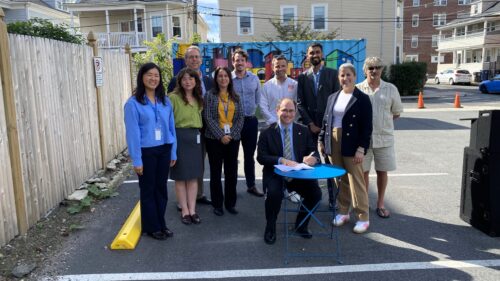
SALEM - September 29, 2025 – Last Thursday, the Salem City Council took a final vote 10-1 in favor of an ordinance filed earlier this year by Mayor Dominick Pangallo that eliminates nearly 60-year-old, arbitrary parking minimums for new multifamily housing in the City. Today, Mayor Pangallo signed the Ordinance into law in an underutilized parking space, alongside City Councilors and staff, members of the Affordable Housing Trust Fund Board and Planning Board, and representatives from the Metropolitan Area Planning Council (MAPC). The City of Salem is the first community outside of MAPC’s Inner Core to eliminate parking minimums as part of local and statewide efforts to boost housing production and more accurately align parking supply with local needs.
Salem’s new Zoning Ordinance eliminates parking minimums for all new multifamily housing with three or more units and requires multifamily projects receiving Site Plan Review to identify how they will address residents’ transportation needs via submittal of Transportation Demand Management plans. It also creates a uniform affordability expectation in the Inclusionary Housing ordinance of 10% of units affordable at 60% area median income (AMI) for eligible projects, exceeding the state standard of 80% of AMI.
Salem previously required 1.5 parking spaces for every one new unit of multifamily housing, with limited exceptions. That ratio was adopted in 1969, when the City increased the requirement from one parking space to 1.5 spaces – setting a mandate that would remain in place for decades. On average, the City and MAPC found that 1.18 parking spaces were built per unit of housing at the multifamily sites studied in Salem, and of the spaces built, 62% of them were occupied and 38% were vacant at the time of study. Households living in multifamily housing on average had a demand for 0.85 parking spaces per unit.
This mismatch between parking supply and demand, as well as an unmet need for housing, made obvious the need for Salem to reform its parking policies accordingly.
“We have an affordability challenge here in Salem, just as many communities across Massachusetts do,” said Mayor Dominick Pangallo. “To make our community a less costly place to live, we must right-size our housing supply to better match demand. Until today, Salem required more parking spaces in its multifamily developments than there is demand or need for. Unused excess parking increases the cost of housing, exacerbates housing cost burdens for those at lower incomes who may not need or want that parking, adds to congestion and traffic by inducing the demand for car ownership, and contributes to heat and stormwater related environmental impacts. Salem needs more homes and less empty asphalt parking spaces at these projects.”
From the City of Salem Planning Board, which offered the following in its unanimous positive recommendation for adoption of the ordinance: “This is a chance for Salem to take control of its future. Eliminating minimum parking requirements is a historic preservation strategy, a climate action, a mobility win and a housing affordability policy rolled into one. It helps make housing more affordable, neighborhoods more walkable, and our city more livable. It aligns with bipartisan best practices and growing momentum across the country. And finally, as we head into Salem’s 400th year, it gives us the local flexibility to, once again, design our City for people, not just for cars as we’ve done for the past half-century.”
Parking minimums are defined as the lowest number of off-street parking spaces required based on the type of activity on a site, codified in Zoning Ordinance or bylaw. Minimums are sometimes called parking mandates, as they create a required baseline. Salem’s new ordinance does not ban or even discourage production of new parking spaces for multifamily housing. Instead, the elimination of the required minimum creates flexibility for projects to provide the amount of parking that meets their needs, often based on market conditions such as proximity to transit and walkability of the project location. Similarly, the new ordinance does not apply to on-street and public parking. Through that flexibility, by allowing projects to right-size the off-street parking provided to their specific context, the City is creating greater opportunity for demand for off-street parking change over time. Although not every Salem neighborhood is ready for parking-light housing today, more will be in the future.
This change also advances other public policy goals of the City, by making it less likely that parking built will sit empty. Excess parking is known to encourage car-dependency, exacerbating traffic, related emissions, and other negative environmental impacts. Surface parking, in particular, impairs stormwater management efforts and contributes to urban heat island effect.
In 2022, Salem’s City Council adopted the Housing Road Map, consisting of 30 strategies and including revisiting the City’s residential parking minimums to meet the City’s housing needs. Mayor Pangallo selected the strategy as a priority for advancement and applied for a technical assistance grant from MAPC in 2024 to support the project, seeking to build upon MAPC’s Perfect Fit Parking initiative. The initiative provides guidance on how much parking is needed for given developments – and how much is too much.
As part of Phase 5, MAPC worked with City staff to examine the fitness of the City’s current parking minimums. This included surveys and overnight parking counts conducted at 14 multifamily sites throughout Salem. The City and MAPC then analyzed parking supply, demand, and utilization at these sites and worked with City staff to share the study findings and hear from residents about their parking and housing experiences at a series of community engagement events. The resulting ordinance was informed by these findings and community input. Salem is the first municipality to directly apply MAPC’s Perfect Fit Parking methodology to inform their zoning changes.
For the City of Salem, the elimination of multifamily parking minimums marks a significant milestone in addressing challenges to creating new housing. On its own, this policy will not solve the housing crisis, but it plays an important role in making it easier and more cost-effective to build new homes. To date, of the 30 strategies in the Housing Roadmap, 13 have been completed and nine others are actively in progress. More information on these efforts is available on ImagineSalem.org.
“We’ve been extremely proud to support the City of Salem with their local zoning ordinance through our Perfect Fit Parking Phase 5 data and research,” said MAPC Executive Director Lizzi Weyant.
“Examples from across the Commonwealth and the country show that parking reform can help produce more housing, lower housing costs, provide growth with limited congestion and air pollution, and improve walkability. These are all priorities that we are working on with communities throughout the MAPC region, and Salem just set a great example of how it can be done. In the coming weeks, we look forward to sharing more detailed case studies of how Salem and other cities and towns in Greater Boston have achieved parking reform success.”
MAPC’s began its Perfect Fit Parking research in 2015 to equip local planners with detailed and accurate information so they can make informed decisions about parking plans and policies. Data from 260 multifamily housing sites across 22 communities in Greater Boston has shown that parking is consistently overbuilt and underutilized – whether in urban or suburban locations. The elimination of parking minimums for new multifamily residential properties provides the greatest ability to right-size the parking supply and allow developments to determine parking that meets the needs of their resident population, while reducing the likelihood that parking will go unused. Forthcoming municipal case studies from MAPC will further highlight how cities and towns in the MAPC region (including Salem) have reformed parking to advance their housing and community development goals.
PRESS CONTACT
Tim Viall
Senior Communications Specialist
[email protected]
C: 508-965-0456