
This Playbook Helps Municipalities and Community Partners Prepare for Local Climate Impacts
By Emma Zehner, Senior Clean Energy and Climate Planner, and Van Du, Director of Environmental Planning
December 2, 2025 - Culvert retrofits. Neighborhood block parties. Zoning bylaws discouraging development in floodplains. Transportation infrastructure assessments. Education about forest preservation. These are some of the wide-ranging initiatives communities across the Commonwealth are leading to prepare for intensifying climate impacts like inland and coastal flooding and extreme heat. More than ever, cities and towns have an important role to play in preparing their communities, infrastructure, and social systems for the impacts of climate change and elevating the voices, concerns, and ideas of community members most impacted.
In September, MAPC, the Pioneer Valley Planning Commission, and the Executive Office of Energy and Environmental Affairs celebrated the launch of the Climate Resilience Playbook – an online interactive tool that local planners and community partners can use to identify and prioritize resilience actions for their communities. The Playbook highlights example projects from across Massachusetts and also identifies new opportunities that could be piloted in Massachusetts communities. Acknowledging that climate threats can impact all aspects of a community, projects span many sectors and themes.
What is the Playbook?
In recent years, municipalities have consistently shared with state agencies, regional planning agencies, and other partners that they need more guidance and resources to effectively implement climate resilience projects, build meaningful relationships with community members and partners (especially those most impacted), and tailor state guidance to varying local contexts.
MAPC and partners hosted a webinar to introduce the Playbook and provide more details on the collaborative engagement process that shaped it, its features, and opportunities to provide feedback on this evolving tool.
Based on extensive engagement with more than 80 cities and towns across the Commonwealth – and roughly an equal number of community partners – the Playbook is filled with ideas, tools, case studies and best practices, and is intended to serve as a starting point for municipalities at various stages of preparing for climate impacts.
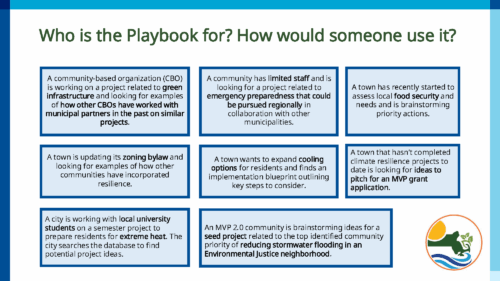
How do you navigate the Playbook?
The online Playbook includes three main elements, described below. For additional guidance, see the referenced sections of the embedded webinar recording.
- Searchable Actions: The Playbook Actions Tool enables individuals to search a list of 120+ relevant actions by climate threats, such as extreme heat, coastal flooding and storm surge, and stormwater flooding, and the database tags actions based on project types (e.g., planning and assessment, policy, education and outreach, etc.). Reference minutes 29:53 - 38:21 in the video above.
- Implementation Blueprints: 20+ of the actions have more detailed “implementation blueprints.” The downloadable blueprints include detailed guidance on implementation steps, potential partners, strategies for leading with equity, and more. The actions that have implementation blueprints are those that were identified as foundational and high impact through extensive engagement and project experience. Reference minutes 29:53 - 38:22 in the video above.
- Planning Resources: The Playbook includes planning resources to support municipal efforts. These range from a guide on how to use the Playbook Actions Tool to guidance on Community Engagement and Climate Resilience Planning and Partnership with Indigenous Communities. Reference 38:23 - 39:21 in the video above.
The Playbook is intended to be an evolving resource, and the project team invites feedback and ideas for additional resources, implementation blueprints, or actions. You can provide direct feedback here.