
The Metropolitan Area Planning Council (MAPC) has released its annual update on permitting activity throughout the Metro Mayors Coalition (MMC), part of the effort to track progress towards the MMC Regional Housing Task Force’s production target of 185,000 net new housing units between 2015 and 2030. This year’s update illuminates the urgency of the housing crisis we are facing in Greater Boston: With only 4,755 units permitted, building permit data for 2024 shows the lowest levels of permitting activity in the almost ten years for which MAPC has been tracking new units across the Metro Mayors communities. While primarily a reflection of difficult market conditions, the 2024 data highlight the need to use every tool in the housing toolbox to come close to the level of production that the Task Force has targeted and is needed to meet regional demand.
Production Tracking Update
Between 2015 and 2024, cities and towns in the Metro Mayors Coalition issued building permits for 76,628 net new units. This represents 62% of the 123,333 units that would need to be permitted by now to keep pace with the 185,000-unit regional production target. This is despite adding two more municipalities, Lynn and Watertown, to the Metro Mayors Coalition since the regional production target was first adopted.
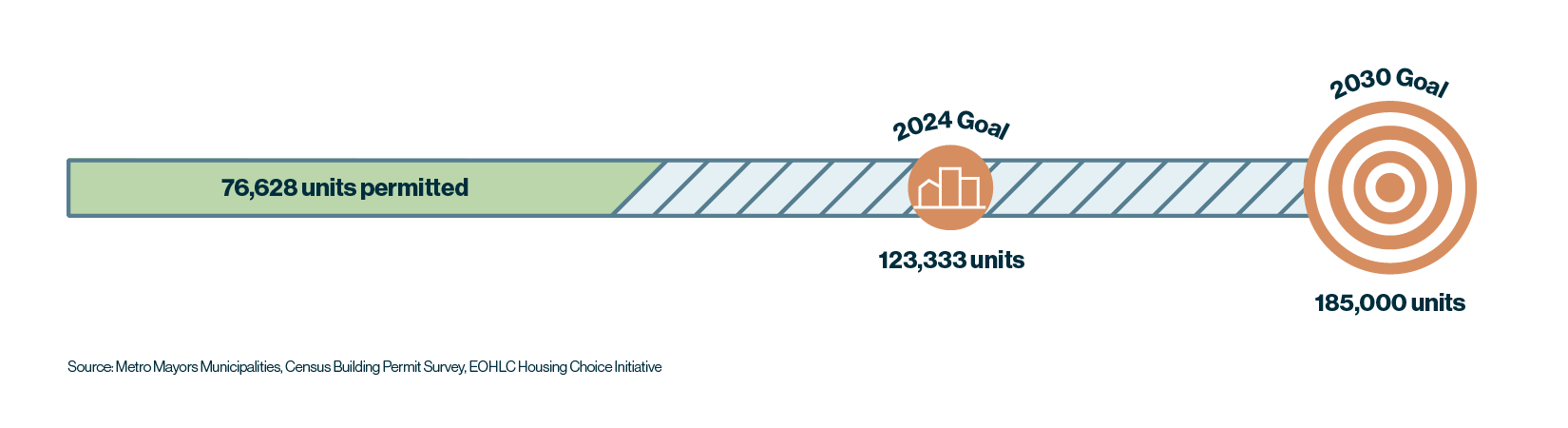
Permitting has declined significantly—by almost 60%—since it hit its peak in 2022 at 11,658 net new units. 4,755 net new housing units were permitted in 2024, far short of the 12,333 units per year on average that Metro Mayors municipalities would need to permit to meet the regional production target. Prior to 2022, the highest number of units permitted in a single calendar year occurred in 2017, with 8,804 units.
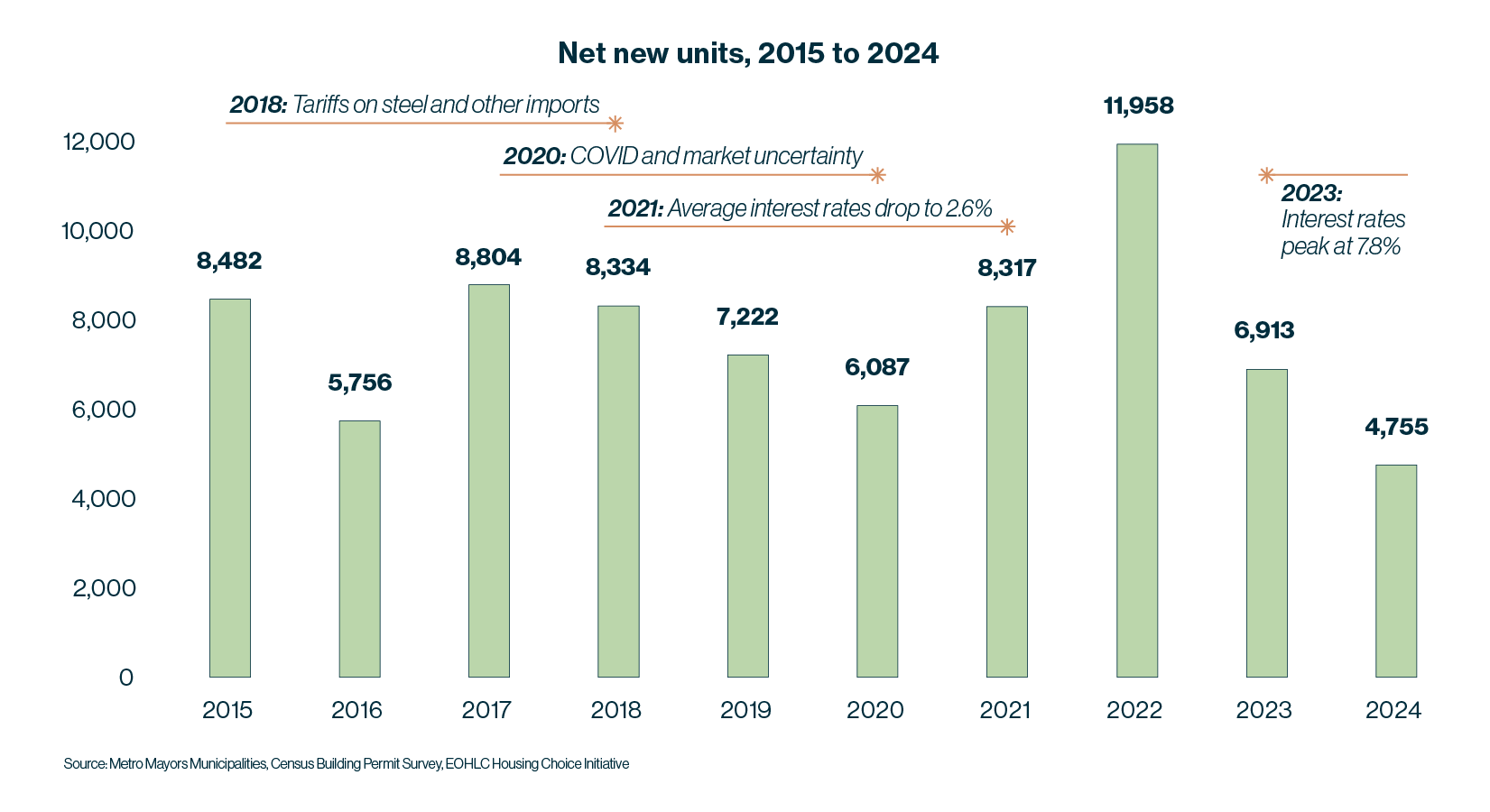
Significant economic headwinds impacting markets nationwide are making it exceedingly difficult for the Task Force municipalities to produce an average of 12,333 net new units per year. Interest rates for a 30-year fixed-rate mortgage peaked in 2023 at 7.8% while construction costs are up 43.5% from their February 2020 (pre-COVID pandemic) numbers. As such, we are seeing permitting numbers at their lowest level in a decade, even as municipalities continue to loosen zoning restrictions that make it more difficult to build multifamily housing. While most of the Metro Mayors Coalition municipalities—due to their status as Rapid Transit Communities—adopted by-right multifamily zoning policies prior to December 2023 in accordance with the MBTA Communities Law, it will take time for the permitting data to reflect the results of these policies, especially due to other headwinds and economic uncertainty, notably the Trump Administration's tariff policy.
Housing Task Force municipalities have permitted a total of 13,176 income-restricted Affordable Housing units, 17.5% of all units permitted between 2015 and 2024. Income-restricted units as a percentage of all units permitted peaked in 2024 at 27.2%, with most Affordable units restricted at 50 to 80% of the Area Median Income (AMI). Despite large fluctuations in permits for market rate units over the past decade, permits for Affordable units have remained relatively stable in comparison. Balancing affordability with production is a major priority for the MMC as municipalities seek to address housing demand along the income spectrum.


Visit the Housing Task Force’s Tracking Progress page for a full update of the 2024 data.
Encouraging Production through Local Implementation Projects & Advocacy
Not keeping pace with the production target means we are not meeting regional housing demand, and not achieving the target will mean higher housing costs than we would have otherwise. This will continue to impact the economic competitiveness of Massachusetts as residents leave for states with lower housing costs, and businesses struggle to find workers. We may begin to see more unintended results, such as higher tax bills for existing property owners to fill gaps in revenue that would otherwise come from new multifamily and commercial development.
While the falling permitting numbers for 2024 are concerning, MAPC and the Housing Task Force are actively undertaking several local implementation projects and advocating for policies to help break down barriers to production and reverse this trend:
- The Leveraging Public Land for Affordable Housing project seeks to provide up-to-date guidance for Metro Mayors communities on how best to utilize one of their greatest assets when it comes to promoting new income-restricted Affordable Housing development: public land. Through comprehensive case study research and mapping/data analysis, this project aims to identify the supply of publicly owned land in the Metro Mayors geography, understand what makes publicly owned land appealing (or not) for Affordable Housing development, identify barriers in existing disposition processes, highlight best practices and opportunities for leveraging public land for Affordable Housing, as well as to provide resources and recommendations for implementation.
- The Rightsizing Zoning project aims to address the issue of municipal zoning nonconformity, particularly the constraints cities and towns face in their ability to preserve the historic built environment and bring new units of housing online. The need to address zoning nonconformities on a case-by-case basis via time-consuming discretionary review processes impacts development feasibility, creates opportunities for legal challenges, and ultimately makes housing development take longer and cost more. Informed by considerable data analysis to identify the districts with the greatest nonconformity and where zoning changes would make the biggest difference, the Rightsizing Zoning project will provide recommendations specific to each municipality for streamlining the permitting and development of new housing that complements historical development patterns and achieves community goals.
- Funded by a $3M US Department of Housing and Urban Development (HUD) grant, the Greater Boston Regional Offsite Construction Strategy (GB ROCS) is exploring innovative ways to build and install modular housing in the region. GB ROCS aims to address three barriers to the production of new income-restricted Affordable Housing units in the Greater Boston region: 1) high construction costs; 2) time to construct new housing; and 3) local opposition to new construction projects. Working with partner municipalities from the Metro Mayors Coalition, state housing partners, subject matter experts, and workforce/labor organizations, the grant will also fund the solicitation for a new manufacturing facility (or facilities) to effectively scale the use of offsite construction as a method of developing housing faster and more efficiently in Greater Boston.
- Through the Housing Task Force, Metro Mayors municipalities advocate for shared fiscal, policy, and programmatic priorities that are critical to addressing the region’s housing crisis. This recent data update shows that more statewide intervention may be necessary to move the needle on production, such as passing the Act to Promote Yes in My Backyard (S. 2836) or allocating funding to help homeowners with ADU financing.
The Metro Mayors Coalition Regional Housing Task Force is a 17-municipality coalition of cities and towns that was established in 2018 to set housing targets and to agree on a set of principles to guide future housing development and preservation. The cities and towns in the MMC include Arlington, Boston, Braintree, Brookline, Cambridge, Chelsea, Everett, Lynn, Malden, Medford, Melrose, Newton, Quincy, Revere, Somerville, Watertown, and Winthrop. MAPC staffs and convenes the Metro Mayors Coalition.