
The Need for Detailed Data on our Existing Affordable Housing Stock
By Adam Ploetz, AICP, Manager of Housing & Neighborhood Development, and Emma Battaglia, Senior Housing and Land Use Planner
December 16, 2025 - MAPC will soon be releasing its annual update on permitting activity throughout the Metro Mayors Coalition (MMC), part of the effort to track progress towards the MMC Regional Housing Task Force’s production target of 185,000 net new units between 2015 and 2030.
In anticipation of the release, we wanted to reflect on Boston Indicator's recent Upzone Update article, The Surprising Lack of Good Permitting Data and What to Do about It (Boston Indicators is the research center at the Boston Foundation). The author Amy Dain highlights the challenges we create for ourselves by not having good administrative systems in place for tracking building permit numbers at the local level.
Dain mentions the importance of collecting accurate housing production data to inform decisions around affordability, public transportation, environmental sustainability, and more. Access to detailed data on their Affordable Housing stock can empower municipalities to more strategically pursue new development that expands Affordable Housing to meet local needs, proactively preserve existing Affordable Housing with term-limited deed restrictions, and implement policies and programs to increase housing affordability.
As in past years' collection of data on permitting activity, administrative challenges continue to exist regarding the tracking of building permits and the burden placed on municipal staff to capture an accurate reading of production and affordability in their community.
Affordable Housing with a capital “A” refers to housing made permanently affordable to households below a certain income through significant government subsidies, tax credits, and financing. It differs from naturally occurring affordable housing (NOAH), which refers to homes that are affordable due to their age, location in lower-cost markets, or smaller size. Affordable Housing has legal systems in place to protect against the market speculation, redevelopment, and neglect that can all impact NOAH.
To help give cities and towns the tools they need to fully understand the nature of the housing challenges in their community, MAPC and the Metro Mayors municipalities have advocated for the passage of An Act Improving Municipal Access to General Existing Housing Data (IMAGE HD). This bill would direct the Executive Office of Housing and Livable Communities (EOHLC) to create a database that makes housing data available to municipalities and regional public entities.
Though communities currently submit detailed data on new developments with Affordable Housing units to EOHLC to have them counted towards a municipality’s percentage on the Subsidized Housing Inventory (SHI), the SHI’s method of calculating affordability tends to overcount income-restricted Affordable units while also failing to reflect affordability across the full low-to-moderate income spectrum. The result of this system is that many units are counted as Affordable when they’re not, and that makes it harder for cities and towns and the state to meet the real housing needs in our communities.
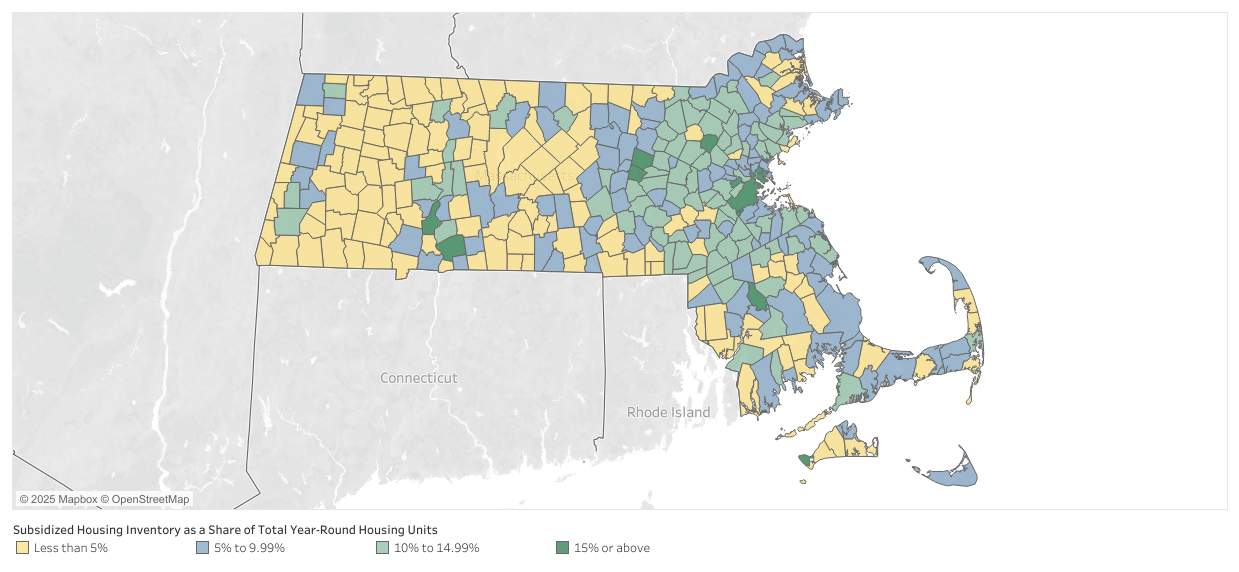
IMAGE HD would direct the EOHLC to establish a statewide database available to municipalities and regional public entities. For new developments, this database would include:
- the total unit count;
- the total count of units with affordability restrictions;
- the Affordable unit count respectively at 30, 50 and 80 percent of AMI;
- terms and end dates of affordability restrictions;
- per unit bedroom and bathroom count;
- per unit livable square footage;
- and location.
Additionally, MAPC hopes to explore reforms through the regulatory process to the standard statewide building permit, such that it can be used to collect the data needed annually to track progress towards the regional production target while also reducing the burden placed on planners to synthesize the data. This would involve convening municipal building and planning officials to discuss what a redesign of their digital permits could look like that also captures useful data for other municipal departments, state and regional agencies, and researchers.
The Metro Mayors Coalition Regional Housing Task Force is a 17-municipality coalition of cities and towns that was established in 2018 to set housing targets and to agree on a set of principles to guide future housing development and preservation. The cities and towns in the MMC include Arlington, Boston, Braintree, Brookline, Cambridge, Chelsea, Everett, Lynn, Malden, Medford, Melrose, Newton, Quincy, Revere, Somerville, Watertown, and Winthrop. MAPC staffs and convenes the Metro Mayors Coalition.