
Local Action Units (LAUs)
A Resource Guide for Municipalities

AdobeStock_698264528
Program Overview
Municipalities across Greater Boston are facing increasing challenges in managing and preserving their affordable housing stock.
Local Action Units (LAUs) are affordable housing units that are created through local municipal action without a comprehensive permit and without direct State financial subsidies. Enabling local actions that municipalities can undertake to create LAUs include special permits, inclusionary zoning, conveyance of public land and utilization of Community Preservation Act (CPA) funds, among others.
Over the course of this project, MAPC partnered with a group of municipalities to better understand the challenges involved in administering Local Action Units (LAUs). A key motivation for this work was the growing concern among municipal staff about large and unpredictable rent increase requests, particularly in the wake of post-pandemic rent increase restrictions.
This online resource guide is intended to serve multiple purposes, and to support ease of use, this resource guide is organized as a web-based tool.
Important Information:
Application Process One Pager (pdf)
LAUs Municipal Duties Checklist (excel)
Project Team Contacts:
Sukanya Sharma
[email protected]
Gwendolyn Hellen-Sands, AICP
[email protected]
News and Updates
Local Action Units (LAUs): A new Resource for Municipalities Release Event Materials
November 17, 2025
- Watch the Webinar Recording
- View the Webinar Presentation
- Questions and Answers Document - coming soon!
Local Action Units (LAUs) 101
What Is A Local Action Unit (LAU)?
Local Action Units (LAUs) are affordable housing units that are created through local municipal action without a comprehensive permit and without direct State financial subsidies. Enabling local actions that municipalities can undertake to create LAUs include special permits, inclusionary zoning, conveyance of public land and utilization of Community Preservation Act (CPA) funds, among others.
Local preference and age restrictions can apply but must be approved by EOHLC. Please refer to EOHLC’s 55+ age restriction policy and federal requirements around 55+ and 62+ developments.
The LAU program provides technical and other non-financial assistance to communities seeking to increase the supply of housing for households at or below 80% of the area median income level.

Map of LAUs by Municipality in the Greater Boston area. Includes that of the 4,591 total LAUs in Greater Boston, 70% are rented, 30% are owned, 2% are age-restricted, and less than 1% area HOME funded. View a larger version of the map and download.
What is Not A Local Action Unit (LAU)?
Typically, these will be:
- Any project that has received a comprehensive permit or state financial subsidy.
- Units built with Low Income Housing Tax Credits (LIHTC).
- Units using MassHousing financing
- Units developed with Affordable Housing Trust Fund (AHTF) or HOME funds (if the funds come from state/federal sources)
- Units financed by state’s rental production programs
- Units using state soft loans or grants
- Most units produced by HOME funds, with the exception if they meet the LIP LAU guidelines and if the HOME program is assigned to the municipality (Local Home).

Image description: A graphic illustrating types of LAU local actions. These include: Inclusionary zoning ordinance (most common), special permit requiring affordable units, contribution of municipal funds, contribution of municipally owned land, negotiation with developers such as MOU (less common), and other zoning such as an overlay district or ADU bylaw (less common).
Local Action Units (LAUs) Application Process and Municipal Duties
Typical LAU Application Process:
Municipal Duties:
Resources for Municipalities
Application Link and State Guidance:
- Executive Office of Housing and Livable Communities (EOHLC) LAU Application
- Request New Units Form for Inclusion on Subsidized Housing Inventory (SHI)
- Local Initiative Program (LIP) Regulatory Agreements
- EOHLC Local Initiative Program (LIP) Site
- Local Initiative Program Policy Guidance Regarding Approval of Local Action Units Developed "As of Right"
- Housing Toolbox for Massachusetts Communities
- The Housing Toolbox is a resource hub that offers guidance, templates and case studies to support local housing initiatives.
- Local Housing Authority Directory
- Regional Housing Services Offices
Templates:
- LAUs Municipal Duties Checklist
- Email Template for LAU Monitoring and Verification (Arlington Monitoring Letter)
- Sample Consent Letter for Refinancing
- Regulatory Agreement Examples (Personally Identifiable Information (PII) redacted)
- LIP Rental Increase Memo
- Annual Compliance Report Template
- Affordability Compliance Letter Template (Beverly)
- Sample Communication from Town Regarding Rent Increase Process (Beverly)
Fair Housing Lottery Resources:
- Metro Housing Boston Fair Housing Resources
- Mass Housing Institute Fair Housing Resources
- Consultants
- Stoneham Fair Housing Lottery Information
- Massachusetts Housing Partnership (MHP) Resources
- EOHLC Fair Housing Resources
Affordable Housing Management Software Examples:
Resources for LAU Tenants:
- Massachusetts Tenant Rights
- Massachusetts Rental Assistance: Housing Vouchers - This site hosted by EOHLC provides information on both state and federal rental assistance programs, including Section 8 Vouchers and Massachusetts Rental Voucher Program (MRVP)
- Watertown Housing Authority - Watertown has a collection of documents and forms related to affordable housing collected on their site
- Housing Navigator Website
- MassHousing Affordable Rental Communities - This site helps renters find workforce and affordable housing options across Massachusetts.
Challenges and Recommendations
Challenges Faced at Municipal Scale:
During municipal focus group sessions, partnering municipalities shared the following challenges they face in LAU administration.
Recommendations:
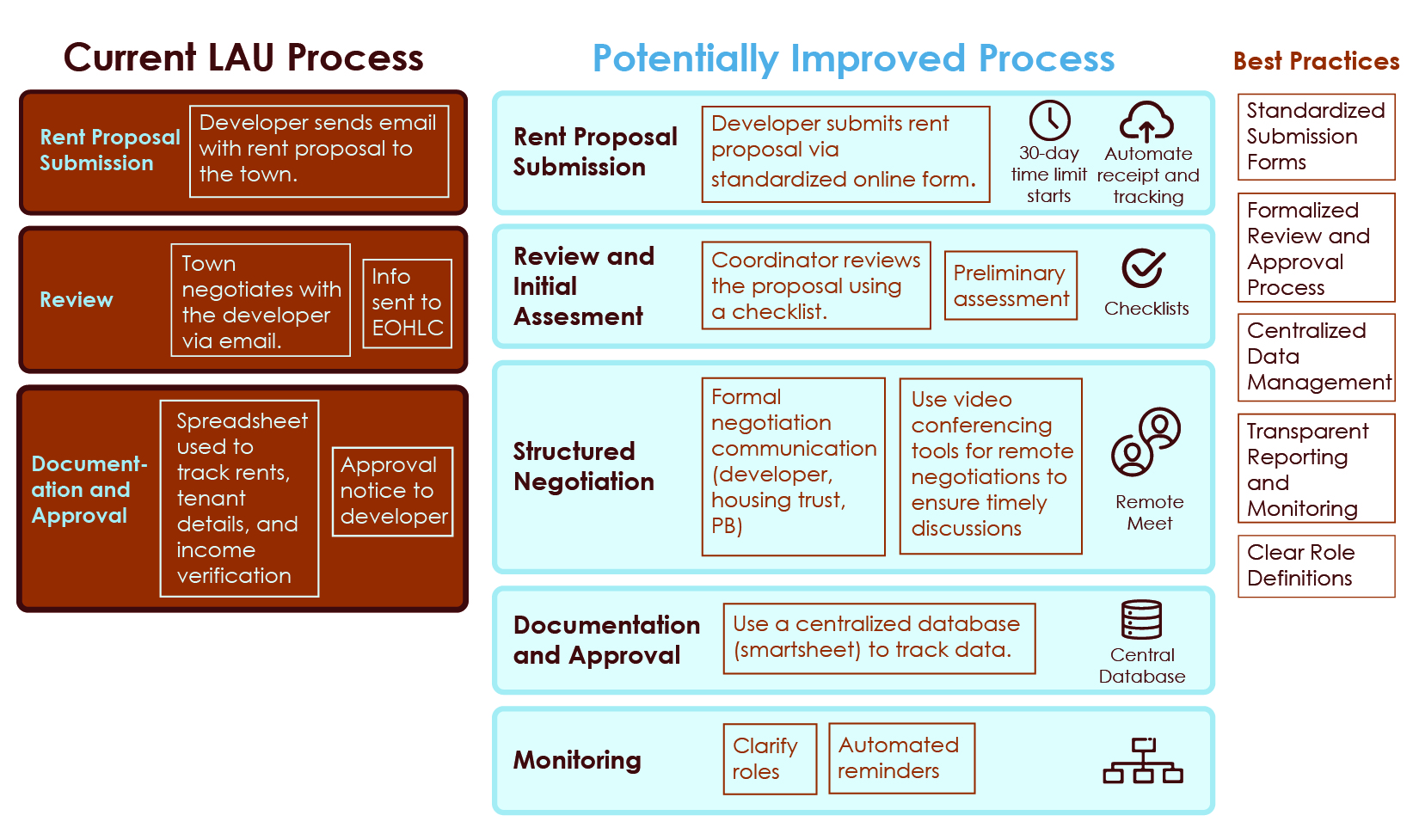
Recommendations below build upon insights gathered from municipal staff, state agencies, and housing professionals who engaged in this effort. As LAU program sees increased utilization there is greater need for stronger support for municipal staff. While some reforms require state-level action, many can be led or piloted by municipalities and regional partners. Additionally, during engagement activities, stakeholders raised a range of promising but complex concepts that generated interest but also surfaced important questions about feasibility, equity, and implementation. These included:
- Exploring the inclusion of internet costs in the utility allowance for affordable housing units, recognizing that internet access is essential for work, education, and daily life. This change would better align affordability calculations with modern household needs and reduce the financial burden on low-income tenants.
- Separate or unbundle parking costs from rent calculations to help lower overall housing costs.
Glossary
Affirmative Fair Marketing Plan
A plan for the marketing of Subsidized Housing Inventory (SHI) Eligible Housing, including provisions for a lottery or other resident selection process, consistent with guidelines adopted by the Department, and providing effective outreach to protected groups underrepresented in the municipality. The plan shall not permit any discrimination on the basis of race, creed, color, sex, age, disability, familial status, sexual orientation, national origin or any other legally protected category in the leasing or sale of SHI Eligible Housing (EOHLC Definition). More information can be found here.
Affordable Housing
Housing that is income-restricted to low- or moderate-income households and typically costs no more than 30% of a household's income.
Area Median Income
Area median income is defined as the midpoint of a specific area’s income distribution and is calculated on an annual basis by the Department of Housing and Urban Development. HUD refers to the figure as MFI, or median family income, based on a four-person household. More information about AMI can be found here, as well as the current AMI for 2025 by county.
Chapter 40B
The EOHLC (Executive Office of Housing and Livable Communities) utilizes Chapter 40B (also known as the Comprehensive Permit Law) as a key tool within its broader housing initiatives to promote the development of affordable housing throughout Massachusetts. Chapter 40B establishes a mandate for every community in Massachusetts to have at least 10% of its housing stock designated as affordable. In communities below this 10% threshold, Chapter 40B allows developers to bypass local zoning bylaws and restrictions to facilitate the construction of affordable housing developments. These developments are required to include a minimum of 20-25% affordable units with long-term affordability restrictions. Access more information.
Community Preservation Act (CPA) Funds
Municipal funds raised through a local property tax surcharge, used to support affordable housing, open space, historic preservation, and recreation. CPA funds can support LAUs. Access more information.
Comprehensive Permit
A streamlined permitting process for affordable housing developments that allows developers to bypass some local zoning if a project meets state affordability criteria. LAUs are not created through this process. The permit is issued by a Board pursuant to M.G.L. c. 40B, §§ 20 through 23 and 760 CMR 56.00. Access more information.
Deed Rider
A legal document attached to the property deed that establishes affordability restrictions, such as resale conditions and income eligibility, to ensure long-term affordability.
HOME Investment Partnerships Program
The HOME Program is a federal housing subsidy program administered by the state, certain large cities, and certain groups of municipalities that have formed a HOME consortium. Access more information.
Income Eligible Household
A household of one or more persons whose maximum income does not exceed 80% of the area median income, adjusted for household size, or as otherwise established by the Department in guidelines. For homeownership programs, the Subsidizing Agency may establish asset limitations for Income Eligible Households by statute, regulations, or guideline. In the absence of such provisions, Income Eligible Households shall be subject to asset and/or other financial limitations as defined by the Department in guidelines. (EOHLC Definition).
Local Initiative Program (LIP)
The Local Initiative Program (LIP) is a state program that encourages the creation of affordable housing by providing technical assistance to communities and developers who are working together to create affordable rental or ownership opportunities for low- and moderate-income households. There are two types of LIPs: LIP 40B Chapter 40B Comprehensive Permit developments (also known as a Friendly 40B) and LIP LAU Local Action Units (LAUs). Local Action Units are created when the units are permitted under an Inclusionary Zoning Bylaw or Special Permit or the units are existing. Monitoring LIP units and developments is a shared responsibility between the municipality and EOHLC. Access more information.
Local Preference
A provision allowing municipalities to give priority in affordable housing lotteries to current residents or workers, subject to fair housing laws.
Lottery Agent
A third-party professional responsible for conducting affordable housing lotteries and verifying applicant eligibility according to fair housing and program rules.
Monitoring Services Agreement
An agreement between a municipality (or its designee) and the developer or property owner that outlines responsibilities for annual monitoring of income eligibility, affordability, and unit use.
Regulatory Agreement
A legally binding agreement that establishes the affordability requirements and administrative obligations for a housing development, including rent caps, income limits, monitoring, and marketing.
Shared Housing Services Office (SHSO)
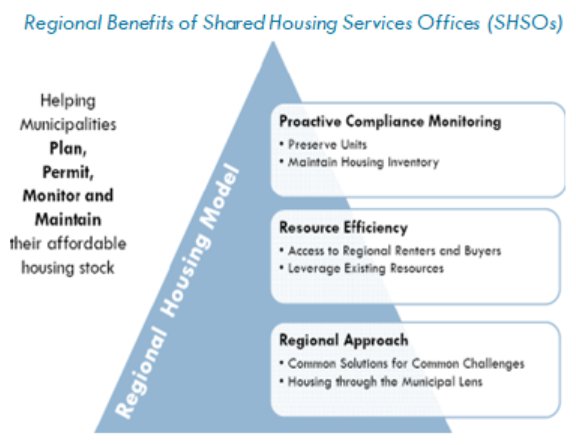
A Shared Housing Services Office (SHSO) is an office shared between multiple municipalities that assists with the functions of affordable housing, including proactive monitoring, program administration, project development and resident assistance. Learn more about RHSO.
Subsidized Housing Inventory (SHI)
The Subsidized Housing Inventory (SHI) is used to measure a community’s stock of low-or moderate-income housing for the purposes of M.G.L. Chapter 40B, the Comprehensive Permit Law. While housing developed under Chapter 40B is eligible for inclusion on the inventory, many other types of housing also qualify to count toward a community’s affordable housing stock. It is a list of officially “affordable” housing units in a community and includes both rental and home ownership dwellings. Subsidized Housing Inventory (SHI) | Mass.gov