
The Accelerating Climate Resilience Grant: The First Five Years of Growth
By Oliver Song, Environment Mindich Service Fellow
September 17, 2025 - As the impacts of climate change intensify, so does the need for municipal leadership and action. MAPC’s Accelerating Climate Resiliency (ACR) program aims to advance climate resilience planning into implementation in Metro Boston through grantmaking, a Resilience Community of Practice, and a publicly available Speaker Series.
All 101 municipalities in the MAPC region are eligible to apply for the grant program. Funded projects in the past five years included but were not limited to capital projects, designs and conceptual plans, feasibility and engineering studies, policy initiatives, capacity building efforts, and those that advance regional collaboration and coordination to accelerate climate resilience in the region. Project scopes ranged from construction of floodplain gardens to installation of shade structures to development of community education and engagement programs.
MAPC prioritized funding and elevating projects that advance and build equity and social cohesion in our communities.
The grant is built on nine grant priorities, which reflect the wide encompassing intersectionality of climate resilience.
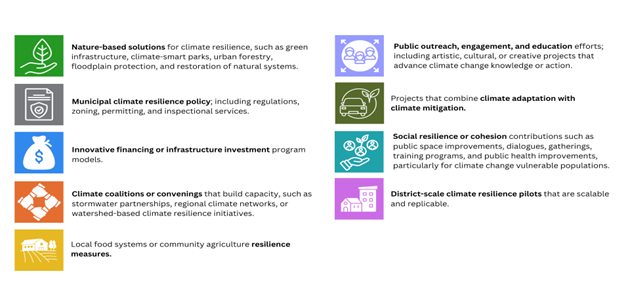
This year, the ACR grant celebrates reaching its five-year milestone. With the success of the program, MAPC announced the awardees in the 6th and next iteration of the program with expanded eligibility to include applications from non-municipal, community-based entities. But first, let’s take a step back to reflect on the historic progress made. Below are findings on the impact of the ACR grant, which serves as the foundation for how the grant will continue to expand its impact and scope in the MAPC region.
Program Details
The grant has to date disbursed $2.68 million to 40 municipalities and 56 projects, with regional representation in all 8 MAPC subregions. Projects ranged from $15,000 to $142,500 depending on the project’s scope and timeline. Each funding round on average added 8 unique municipalities to the grant’s coverage.
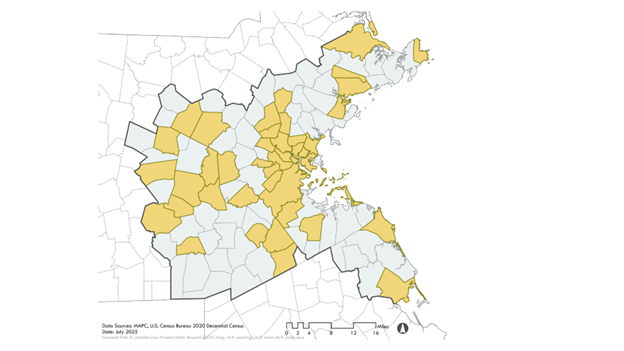
Of the funded projects, 39% of projects took place in the Inner Core subregion, 14% in the North Shore subregion, 11% South Shore subregion, and 11% in the Three Rivers subregion. Awarded municipalities vary in terms of geographic distribution, municpal demographics, and climate risks targeted.
From ideation to implementation, each project incorporates a focus on one or more grant priorities. The cumulative representation from all 5 years of projects demonstrates that all 9 strategic priorities are represented. Among the highest represented priorities are: Coalitions or Convenings at 20%, Social Resilience at 20%, and Food Resilience at 13% of funded projects.

The distribution of priorities demonstrates not only the synergies between the strategic priorities but also serves as a helpful indicator of the most popular strategies for fostering climate resilience. Coalitions or Convening projects often found strong connections with Social Resilience, given that the process of stakeholder engagement and forming partnerships were often paired with social resilience contributions that targeted a wide range of outcomes from increased public health to watershed management, for example.
Looking Onwards
The ACR grant has had a storied history since its inception in 2020.
Round 1: In this pilot round, municipalities applied for funding for one-year projects. MAPC funded 11 municipalities totaling about $360K, demonstrating the pilot’s success and fueling momentum for future rounds.
Round 2: With the renewal of the program by the Barr Foundation, MAPC funded 11 municipalities around $740K total. This is the first time municipalities could apply for funding for multi-year projects.
Round 3: Eleven projects were funded totaling around $410K. The Resilience Community of Practice and additional programming such as site visits were introduced. This is the first year that featured multi-municipality collaborations, where more than one municipality could collaborate on a project and seek funding.
Round 4: At 13 projects and $835K awarded, this was the largest and most successful grant round yet. Among the projects funded, Arlington, Stoneham, and Winchester received an APA-MA Award for their project on Sustainable Landscaping, demonstrating the grant’s far-reaching impact.
Round 5: MAPC funded 10 projects at $350K total and presented the grant at two national conferences. In April 2023 at the American Planning Association conference in Philadelphia, MAPC hosted a panel discussion where municipal leaders from four funded projects were able to share their successes and challenges with their projects. In May 2024 at the National Adaptation Forum in St. Paul, Minnesota, MAPC was selected for a poster presentation on the ACR program which highlighted case studies of awarded projects and their impacts on communities’ climate resilience planning and implementation.
Round 6: MAPC is proud to launch the next iteration of the ACR Grant Program with expanded eligibility to include applications from non-municipal, community-based entities. Total funding requests approached $3.9M and the information on latest grant round can be found here: www.mapc.org/resource-library/accelerating-resiliency.
Acknowledgements
The ACR Program team would like to thank all the municipalities and community-based organizations who have put countless hours into their projects, applications, and reporting to support broader efforts to foster climate resilience. Finally, we would like to thank the Barr Foundation for their generous support of the ACR program.