
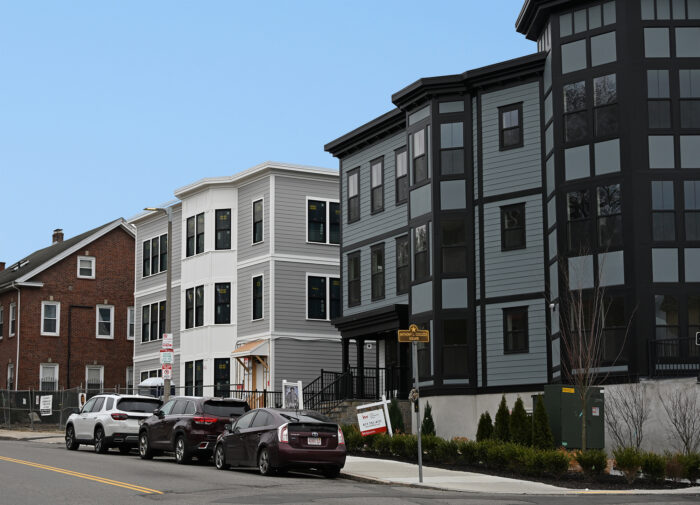
Just over two years ago, Governor Maura Healey signed the Affordable Homes Act (AHA) into law, representing the largest investment in housing production in Massachusetts history.
The law dedicates 80% of funding to benefit low-income households, with half the funding dedicated to extremely low-income households and residents with disabilities. This historic legislation authorized $5.16 billion in spending over five years along with nearly 50 policy initiatives to address the Commonwealth’s housing crisis.
MAPC played an important role in advocating for various components of the bill that became law, including allowing Accessory Dwelling Units (ADUs) by right, the Commercial Property Conversion program, creation of the Momentum Fund to accelerate mixed-income housing construction, and much more.
Additionally, several important elements of MAPC’s long-range visionary plan for the region, MetroCommon 2050, were advanced, including expanding rental and homeownership opportunities by enforcing antidiscrimination protections; creation of the Office of Fair Housing; decarbonizing the building sector, particularly public housing; and accelerating statewide building retrofits by funding deep energy efficiency and electrification.
Following adoption of the AHA, MAPC immediately turned to implementation, partnering with the Commonwealth, municipalities, and others to ensure key parts of the law are put into place on the local level as intended.
Reducing Barriers to Production and Preservation:
A Look at 3 New Policies
The AHA requires, for the first time, that Massachusetts create a state housing plan at least every five years.
MAPC played an integral part in the inaugural 2025 plan, A Home for Everyone, serving as the part of the state’s data team in partnership with the UMass Donahue Institute. The plan established a production goal of 222,000 new homes by 2035 to meet demand and stabilize costs. Strategies focused on increasing production, preserving existing homes, supporting residents struggling with housing costs, and strengthening the safety net for vulnerable residents.
The AHA made accessory dwelling units (ADUs) permissible by right in all municipalities within single-family zoning districts, reducing local barriers to the creation of additional housing units. MAPC immediately fielded interest in the new policy from our member municipalities and created a resource page to support local implementation. We also partnered with state agencies to develop a Model Zoning for ADUs Guide to help communities regulate ADUs in accordance with state law, and we have continued to engage with a variety of municipalities throughout the region with ADU-related technical assistance.
Over the last few years, we have also helped to update zoning in Littleton, Danvers, and Marblehead and convened the Metro Mayors Coalition Housing Task Force to support implementation in some of the Commonwealth's most populous communities.
The AHA reformed the disposition of surplus public land, creating streamlined pathways for state agencies and quasi-public entities like DCAMM, to make publicly controlled land available for new housing. Beyond advocating for this reform, MAPC is working with the Metro Mayors Housing Task Force to more closely examine opportunities for Affordable Housing on municipally owned surplus property and we expect to release this research in the new year.
The Affordable Homes Act also established the state's first dedicated Office of Fair Housing, a long-held MAPC policy priority. A state-level fair housing office provides a centralized structure to protect residents, safeguard critical funding, and proactively enforce the Commonwealth’s civil rights protections. By situating this office in HLC, it allows the issues, regulations, and requirements associated with fair housing to be centered in reviews of state-backed affordable housing investments and in considerations on overall housing policy.
The law also established a trust fund for enforcement initiatives, fair housing testing, education, and outreach. Committing state resources to advancing fair housing is even more critical currently as the federal government pivots away from their responsibilities, oversight, and enforcement of certain existing housing laws.
Continued Advocacy
While the Affordable Homes Act was monumental and advanced several of MAPC’s policy priorities, there are still opportunities to address our continuing housing crisis.
One key area of focus is ensuring local options, including both a transfer fee and a tenant opportunity to purchase, are available for communities that want to do more to advance these key priorities.
A transfer fee is an important local option tool that municipalities – particularly affordable housing trusts -- could employ to raise revenue for affordable housing development. Nearly 30 communities have filed home rule petitions without success, signaling a clear desire for this policy. If the Commonwealth passed this policy, communities could decide to create a customized fee, tailored to local needs and market conditions, to generate dedicated funding for new affordable housing.
Similarly, a local option Tenant Opportunity to Purchase Act (TOPA) would allow residents in certain multifamily buildings to match a legitimate offer if their property comes up for sale. As written, the policy would also allow residents to designate their right of first refusal to partner with a non-profit, local housing authority, or affordable housing purchaser, to ensure residents can stay in their homes. MAPC was thrilled to see that a version of TOPA was included in both the House and Senate’s 2026 Economic Development Bond Bill and we will continue to advocate for the Legislature to give communities the tools they need to build additional housing and to protect naturally occurring affordable housing.