
Boston to Blue Hills
Creating a vision for walking, biking, and rolling connection from the Neponset River Greenway to the Blue Hills Reservation
AdobeStock_248561346
The Metropolitan Area Planning Council (MAPC) and the Neponset River Watershed Association (NepRWA) are conducting a community process to determine if community members are interested in a walking, biking, and rolling connection from the Neponset River to the Blue Hills Reservation.
This project will have multiple opportunities for community engagement. To date, MAPC and NepRWA have met with numerous community groups, advocacy organizations, as well as local and state officials to hear their feedback. A full project timeline is available below.
Stay Updated on this Project!
Sign up to join our email list to stay up-to-date on the Boston to Blue Hills Project.
Background
The Blue Hills Reservation is one of the largest parks in the Boston region, with several high points, and relatively close access to open space to the City of Boston. Although it’s one of the most popular parks, it’s not easily accessible by foot, bike, or public transit.
This project aims to create a vision for a continuous greenway corridor (or multiple) between Boston and the Blue Hills. We are broadly defining a “greenway” as a corridor of open space for walking, cycling and rolling. The greenway could be a combination of shared use paths and protected bike lanes (with adjacent sidewalks).
There are several greenways that exist or are planned between downtown Boston and the Blue Hills, but they don’t all create a continuous connection to the places people may want to go. We’re hoping this project can help fill a long-overdue gap in the greenway network to allow more people to access the region’s largest public park by foot, bike, or other wheeled device.
Note: By “rolling” we refer to other types of personal wheeled mobility besides bicycling, such as wheelchairs, walkers, scooters, mopeds, skateboards, and more.
The Department of Conservation and Recreation (DCR) is working on a similar project to connect the Readville area to the Blue Hills via a walking, biking, and rolling connection. This is a separate, but related project. Learn more.
Project Team
Throughout this project, if you have any questions or concerns, feel free to reach out to the project team.
Marah Holland (Project Manager)
Senior Transportation Planner, MAPC
617-933-0748
David Loutzenheiser
Senior Transportation Planner, MAPC
617-933-0743
Andres Ripley
Greenways Manager, NepRWA
781-575-0354 x301
The Central Transportation Planning Staff (CTPS) to the Boston Metropolitan Planning Organization (MPO) recently finished a project to evaluate improved transit options from Boston to the Blue Hills. To learn more about their project, View the Final Story Map.
Boston to Blue Hills Envisioned Network
The Boston to Blue Hills Project Team, along with numerous community partners, have created a vision for a walking, biking, and rolling route that connects the Neponset River Trail from Mattapan Square to Milton, the Blue Hills Reservation, Quincy, Wollaston Beach, and back to the Neponset Trail in southern Dorchester.
Through public meetings, one-on-one engagements, tabling events, a public survey, and focus groups, the top priorities we heard for this route include equity, accessibility, safety, enjoyability, sustainability, and ease of use.
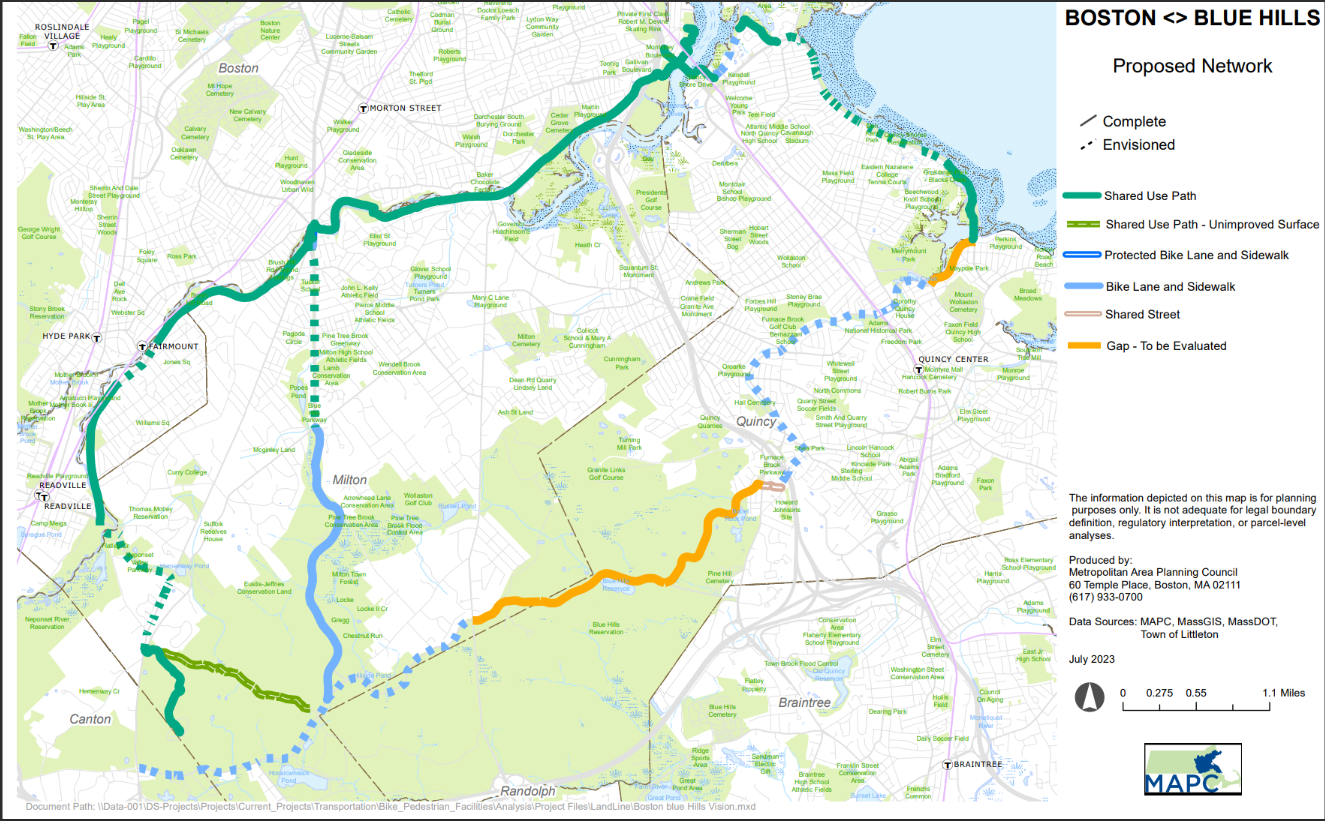
Map description: A map of the proposed Boston to Blue Hills network across the Greater Boston region. It includes different colored lines denoting different types of paths: green for a shared path use, light green for a shared path use - unimproved surface, blue for a protected bike lane and sidewalk, light blue for a bike lane and sidewalk, light pink for a shared street, and orange for a gap to be evaluated. The colored lines have two forms. A solid line represents a completed path, and a dashed line represents an envisioned path.
How Can I Be Involved?
There are numerous ways to get involved with the project and provide your input. Here are a few current and upcoming opportunities:
Resources
Blue Hills Parkway Community Meeting Presentation Slides
On January 17, 2026, the project team hosted a community meeting at Milton High School to share the different potential Blue Hills Parkway design alternatives and to get feedback and input on. View the meeting presentation slides.
Landline: Our plan for a connected greenway network
LandLine is MAPC's vision to connect our greenways and trails into a seamless network. The plan has been developed in coordination with the LandLine Coalition, a group of 40 volunteers representing a number of local agencies and advocacy groups.
LivableStreets Alliance’s Emerald Network
The Emerald Network is a vision for 200 miles of seamless shared-use greenway paths in the urban core of Boston and its adjacent cities.
Boston’s Green Links Project
Boston Green Links is a citywide plan to connect people in every neighborhood to Boston’s greenway network. We do this by installing new paths and bike facilities, and safer road crossings.
Go Boston 2030
Go Boston 2030 is the City of Boston’s comprehensive transportation plan. This plan envisions a city where all residents have better and more equitable travel choices.
Department of Conservation and Recreation’s (DCR) Parkways Master Plan
The Plan articulates a vision for an interconnected network of walkways and bikeways throughout metro Boston that provide residents of all ages and abilities with access to recreational destinations and healthy transportation opportunities.