
Statewide Data Tool Updated for Easier Viewing, Downloading, and Usability
By Tim Viall, Media Relations Manager
September 2, 2025 - DataCommon – an open data resource that provides information on demographics, employment, education, tax revenue, and much more for every Massachusetts city and town – has been upgraded to improve the site’s legibility, navigation, and provide easier access to exact numbers and data. First launched in 2006, DataCommon is a resource for everyone in the Commonwealth seeking to understand their communities.
The DataCommon Community Profiles homepage serves as a map, literally and figuratively, for MAPC’s “Community Profiles.” Each of the 351 cities and towns’ profiles lets you explore aggregated data from state and federal agencies, as well as data from MAPC’s own planning and research work. The profiles provide a single location where you can access and download information about any municipality.
“Prior to these updates, people who visited the site were having a hard time getting data out of the website, which presented a significant area for improvement,” said Digital Services Manager Stephen Larrick.
“Planners, city and town officials, and journalists all need exact numbers to put them into a plan or a story and bring into charts and presentations. Users can now download all of the data and charts into one excel workbook, download each chart individually, view them on screen, and scroll to see data. There are a lot of ways to interact with the site”
Digital Services Manager Stephen Larrick provides a walkthrough of DataCommon's new features.
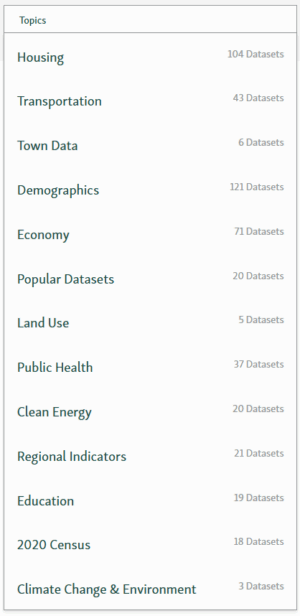
Users also have the opportunity to dig into the data, with 474 datasets organized into 13 categories. Datasets are searchable and downloadable in formats that allow users to pull the numbers directly into Excel, GIS mapping programs, and now JSON / geoJSON file formats are supported download options. Most datasets are available for municipalities and census tracts so that users can drill down to the neighborhood level; some are also available for census blocks and block groups.
MAPC’s Data Services team held focus groups and user testing sessions with planners, researchers, and staff to better understand users’ experiences, needs, and prioritize improvements for the site.
“The user testing process allowed us to better understand where the Community Profiles pages were falling short of meeting user needs and to prioritize fixes and new features for this update,” said Alexa DeRosa, an analyst on the Data Services team who served as project manager for this work.
“We’re confident that the updates we’ve made to the site, based on feedback from our own urban planners and researchers, will make it a better tool for all users, but we are also hoping to collected feedback from users beyond our own agency in the coming year.”
To begin collecting feedback from all users for the next round of site improvements, all pages on DataCommon now include links to two feedback forms.
“We have a new form to submit requests regarding the data, whether there’s a possible problem or if there’s a dataset you want that you’re not seeing, said DeRosa. “The button will bring you to an Airtable form to fill out describing what data you need – even if it’s entirely new, what improvement you’d like to see to the data, and when you would need the information by.”
Striving for continuous improvement, there is also a form on DataCommon for general website feedback, additional ideas on Community Profiles, or any bugs encountered. Questions can also be sent to [email protected].