Protected: Generalist Planning | Land Use
There is no excerpt because this is a protected post.
Continue reading...
There is no excerpt because this is a protected post.
Continue reading...There is no excerpt because this is a protected post.
Continue reading...In early 2025, MAPC’s Council adopted a Strategic Plan to guide our work for the next five years.
The Strategic Plan includes an updated mission statement, vision, and values for MAPC. It outlines the five strategic priorities, derived from our MetroCommon2050 regional plan, that MAPC will focus its work on.
Additionally, it identifies internal changes to improve our effectiveness, support our staff, and lead to more impactful and equitable outcomes for our region.
Eric Hove, Director of Strategic Initiatives ([email protected])
The Strategic Plan addresses the fundamental questions of who we are, what we do, our vision for the future, and the values we seek to uphold. It also identifies what critical topics MAPC should focus on over the next five years (although there will always be surprises!), as well as how we do our work internally.
As part of this planning process, we explored where our technical assistance, advocacy, engagement, and research can deliver the most impact.
2025 – 2030 Strategic Priorities:
Established in 1963, the Metropolitan Area Planning Council (MAPC) has served the 101 cities and towns of Greater Boston for over sixty years. Below you will find links to our last decade of Annual Reports and Work Plans. How we define each:
Annual Reports: Each report focuses on projects, accomplishments, and regional successes for per calendar year.
Work Plans: Each serves as a roadmap for a certain time span – guiding MAPC’s efforts to address the evolving needs of the Greater Boston municipalities, leverage new opportunities, and align local actions with long-term regional goals.
Are you looking for the annual Subregional Reports? Please visit the Subregions webpage.
Annual Plans:
MAPC’s Communications Team ([email protected])
Work Plans:
Eric Hove, Director of Strategic Initiatives ([email protected])


The Vision
By 2030, Greater Boston will be a thriving, inclusive, and climate-resilient regional economy – where all residents, regardless of race, income, or geography, have access to quality jobs, stable and affordable housing, resilient infrastructure, and opportunities to build wealth and shape their communities.
The region will lead not only in innovation, but also in equity, sustainability, and shared prosperity.
The Roadmap
Thriving Together: Greater Boston’s Economic Roadmap (the Roadmap) charts a bold, inclusive course for the region’s future. Grounded in data analysis, stakeholder input, and regional collaboration, it addresses the intertwined challenges of economic vitality, housing, infrastructure, equity, and climate resilience.
The Roadmap prioritizes an economy where opportunity is accessible to all, closing racial and geographic wealth gaps and strengthening pathways to good jobs through education, training, and child care support.
Funding, Support, and Community Input
Resilience Region 2030 Outreach
Questions?
Raúl González
Principal Economic Development Planner
[email protected]
Thriving Together: Greater Boston’s Economic Roadmap 2025 – 2030, focuses on nurturing Black, Indigenous, and People of Color and Women-owned businesses, fostering innovation in sectors such as life sciences and climate tech, and revitalizing local commercial centers.
It also emphasizes investment in affordable housing, transit, broadband, and resilient infrastructure, while advancing a clean energy economy that protects communities most vulnerable to climate change.
This Roadmap is informed by the region’s Comprehensive Economic Development Strategy (CEDS), which provides the underlying data. This work included and would not have been possible without the insight and partnership of the advisory committee (View the Acknowledgments Section, page 3).
Regional Alignment
Connecting local priorities with MetroCommon 2050, MAPC’s regional land use and policy plan, to promote sustainable growth, equity, and resilience across the region.
The Roadmap reflects a shared commitment to sustainable development, economic equity, climate adaptation, and innovation, ensuring that Greater Boston is prepared not only to compete but also to thrive in a changing economy.
Funding and Support
This initiative has been made possible with generous financial support from the Commonwealth’s District Local Technical Assistance Program, MAPC’s Technical Assistance Program (TAP), and other state and local sources. It continues to support municipalities in implementing projects that align with MetroCommon 2050 and Thriving Together: Greater Boston’s Economic Roadmap. Together, these resources empower the region to plan collaboratively, address systemic inequities, and build a more competitive, climate-ready economy.
Community Input
The development of this Roadmap would not have been possible without the insights, experiences, and vision shared by residents, business owners, nonprofit leaders, workers, students, and community organizations across Greater Boston.
We are deeply grateful to all who contributed their time, ideas, and lived expertise to ensure that this Roadmap reflects the hopes and needs of the diverse communities it is designed to serve.
In August 2025, the MAPC Executive Committee voted unanimously to appoint Lizzi Weyant as the next Executive Director for the Metropolitan Area Planning Council (MAPC).
While Lizzi has been with MAPC since 2015 and has served numerous roles during that time, we are excited for this opportunity for you to get to know her in the Executive Director role!
Questions and Answers with Lizzi
Ten Facts About Lizzi
Announcement Press Release
Read Lizzi’s Bio

2025 Annual Council Meeting Panel Discussion. From left to right: MAPC Executive Director Lizzi Weyant (standing behind the podium); Ms. Bernadette Jordan, Consul General of Canada to Boston; Massachusetts Lt. Governor Kim Driscoll; and Boston Mayor Michelle Wu | Photo Credit: MAPC
Can you tell us about the roles you have held at MAPC over the past 10 years?
I came to MAPC in 2015 to run the Government Affairs program as Manager of Government Affairs. I was promoted to Director of the team a few years later, just before COVID. During COVID I helped to work with a team to lead our regional response to the pandemic for the cities and towns that we serve, and communities across the region. I was promoted to Deputy Director in December 2021 and Deputy Executive Director in June of 2023.
What are you most excited about as MAPC’s Executive Director?
I’m really honored to be in this role, and to shepherd the work of this agency. Cities and towns are in the perfect position to lead on issues that impact all of us, especially right now, and especially on issues related to climate change, resiliency, emergency preparedness, and housing. Our state is not going to move backwards on our commitments to the people who live and work in our region, and I am so glad that MAPC is a partner in this work.
What is something about MAPC that makes it unique?
There are so many things that make MAPC unique! Unlike many of our sister planning agencies, we are not the Metropolitan Planning Organization (MPO), but we serve as the Vice Chair of the MPO. Most planning agencies around the country have traditional planning and data departments, but at MAPC, we were one of the first planning agencies to have planning expertise in Clean Energy, Public Health, and Arts and Culture. We also have a robust Government Affairs team and we can take positions on state and federal legislation. MAPC centers equity in our approach to planning, and works to build strong relationships with residents in our region, and especially residents who have been historically disenfranchised from the planning process.
I also tell anyone who will listen that MAPC is unique because we have the smartest, most heart-forward staff I have ever met. Every person who works at MAPC is here because they are committed to making our corner of the world a better place. It is an amazing thing to get to work with people like this every day.
What are some of your goals for your first year as Executive Director?
I have some internal and some external priorities I’d like to undertake. In these uncertain times, I’m committed to making sure that MAPC continues to stand on sound financial footing. I am eager to make our work more regional, and to bring the many different backgrounds and areas of expertise among our staff more directly into our project work. I’m eager to hear from municipal leaders about priorities at the local and regional level and to help our cities and towns share best practices so that we can solve problems together.
Anything else you would like to share?
When I came to MAPC 10 years ago, I knew I’d found an organization where I could work with people who shared my passion and a commitment to serving the residents that live in our cities and towns. I know that this is a team that never shies away from doing the hard work we need to do to make our region and our Commonwealth stronger and I’ve seen that time and time again as our communities have faced COVID, extreme weather events, and now so much federal uncertainty. I believe that cities and towns are leaders in answering our toughest local challenges, and I’m so glad to be in partnership on this important work.

From left to right: MAPC Executive Director Lizzi Weyant and Massachusetts Governor Maura Healey | Photo Credit: MAPC
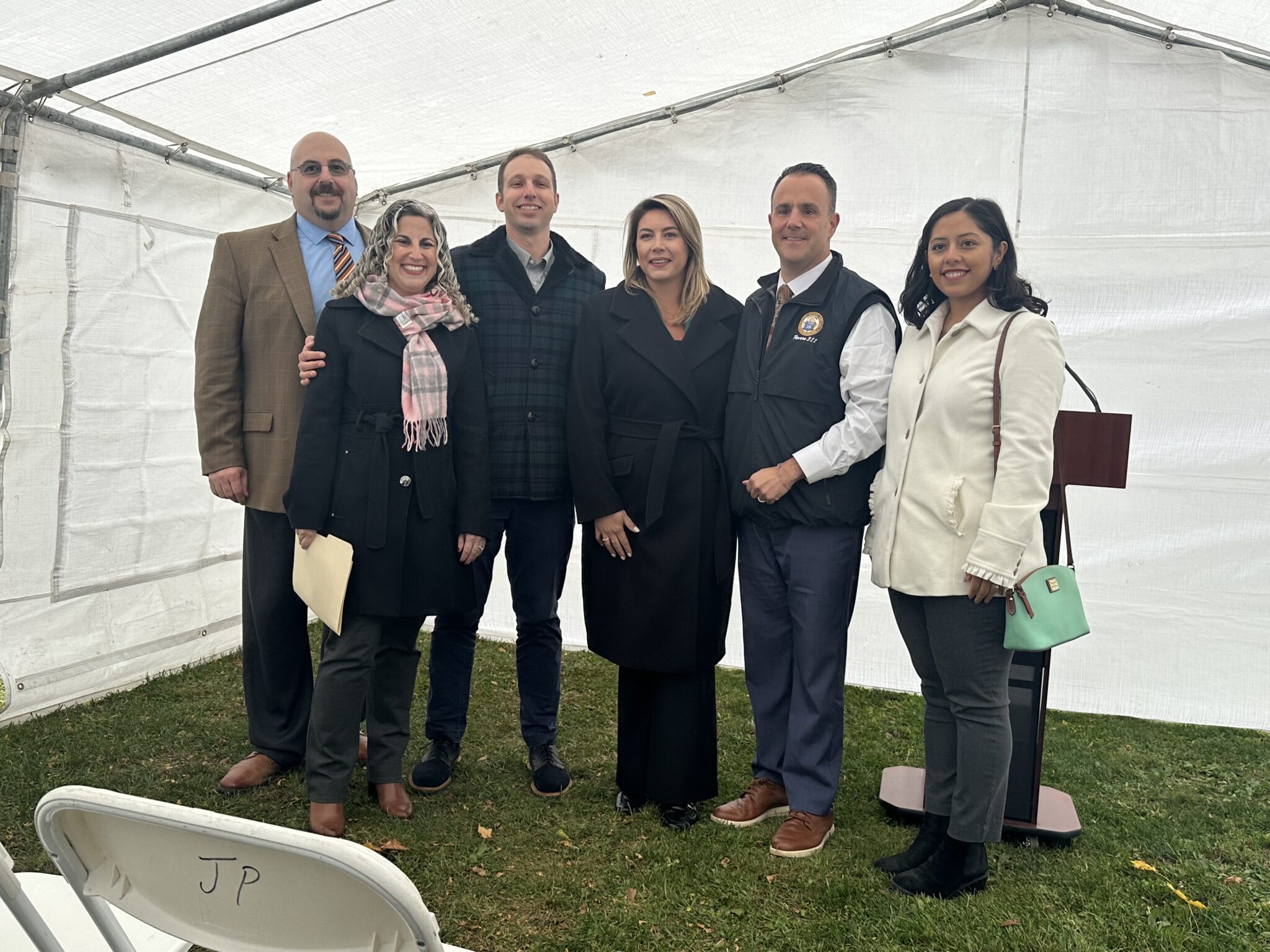
Revere Apartment Wi-Fi Launch, November 2023. Pictured from left to right: Executive Director of the Revere Housing Authority Dean Harris, MAPC Executive Director Lizzi Weyant, MBI Director of Program Development Josh Eichen, Representative Jessica Ann Giannino, Mayor of Revere Patrick Keefe, and Revere School Committeewoman Jacqueline Monterroso | Photo Credit: MAPC

In MAPC’s 62-year history, Lizzi is the agency’s first female Executive Director.

Lizzi is originally from Philadelphia, Pennsylvania. Go birds!

Lizzi got a Bachelor of Science in Philosophy for her undergraduate degree. She originally thought she wanted to be a doctor like her older brother.

Lizzi met her husband in college, and they took one class together on the Vietnam War. Her husband got an A and she got a B, and they got married anyway.

Lizzi has two children who are turning her into an Olivia Rodrigo, Dua Lipa, and Taylor Swift fan, though her first music love will always be her parents’ Simon & Garfunkel records.

For a short time, Lizzi lived in Washington, DC, which is why she’ll never complain about Boston traffic, even as she hopes you’ll get out of your car and onto the T.

Lizzi knew she was a true New Englander when she gave a tourist directions downtown using only Dunkin’ as a landmark.

Lizzi loves to cook and often uses it as a stress relief. She’ll gladly share any recipe and will order way too much food for any gathering she’s in charge of.

In her spare time, Lizzi likes to read. Her current favorite books are by Frederik Backman.

Once upon a time, Lizzi studied classical ballet and thought she might be a ballerina. She can still do a pirouette.
