From Risk to Recovery: A Community Resilience Conference

The Why
The Metropolitan Area Planning Council (MAPC) is hosting this regional emergency preparedness conference in direct response to needs identified by municipalities across the North Shore Task Force Communities. Through a series of conversations with residents and municipal focus groups, residents and local officials shared common challenges, gaps, and priorities related to preparedness, response, and recovery, particularly as communities face increasing climate, infrastructure, and public safety risks.
This conference was designed to translate those needs into practical, actionable guidance for municipal staff. By bringing together local, state, academic, and nonprofit partners, the event creates space for municipalities to learn from one another, strengthen regional coordination, and better understand available resources before, during, and after emergencies.
While the conference is intended for municipal staff, its ultimate goal is to build stronger local capacity so communities are better positioned to protect residents, recover more quickly from disasters, and plan more effectively for future risks. Hosted through MAPC’s Emergency Preparedness Practice and supported by a Technical Assistance Program (TAP) grant, this convening reflects MAPC’s commitment to regional collaboration, shared learning, and resilient communities. To learn more about the data collected to inform the planning process of this conference, please click here..
From Risk to Recovery: A Community Resilience Conference
About Tara Hughes: Our Keynote Speaker
Tara 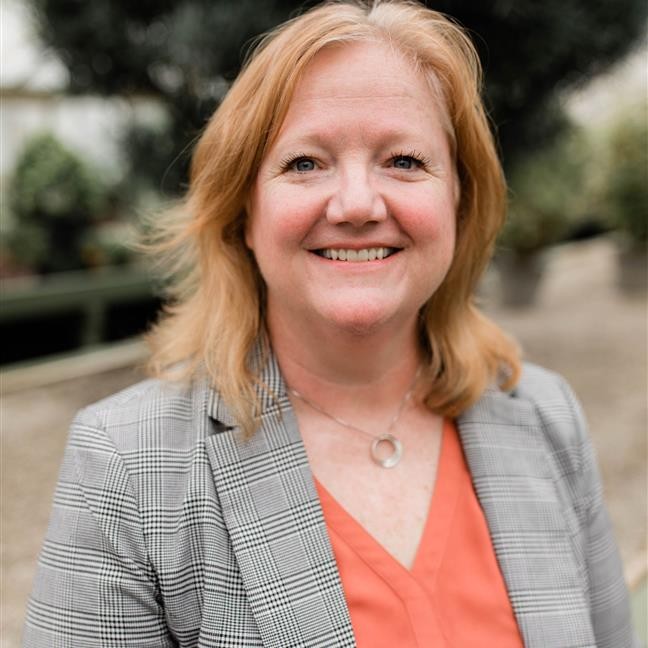 is a Subject Matter Expert in Mass Violence response and has worked directly with victims and families to ensure comprehensive care. She is the Disaster Mental Health (DMH) Advisor for the Northeast Division of the American Red Cross and has responded to mass casualty incidents and other disasters on behalf of the Red Cross for over 20 years.
She is previous Project Director of Improving Community Preparedness to Assist Victims of Mass Violence or Domestic Terrorism: Training and Technical Assistance Program (ICP TTA) which delivered TTA to local, state, regional, and tribal jurisdictions across the country, including U.S. territories, to augment existing emergency response plans to ensure effective response to incidents of criminal mass violence and domestic terrorism.
Tara has worked with the federal Department of Justice’s Anti-terrorism and Emergency Preparedness program to assist communities impacted by mass violence incidents to care for victims for up to 3 years post-incident.
She is the current Director of the Bureau of Justice Assistance National Training and Technical Assistance Center (BJA NTTAC). She oversees the facilitation of training and technical assistance (TTA) for the criminal and legal systems, including law enforcement, violence prevention and the legal and court system.
She has extensive experience working in mass violence/casualty incidents, with a focus on violence that impacts large numbers of people and whole communities. Tara uses her experience in trauma counseling and crisis response to ensure compassionate and effective care of people impacted by incidents. Her immediate response history encompasses a wide variety of incidents, including the crash of Colgan Air Flight 3407, Haitian earthquake, Newtown, CT Sandy Hook school shooting, Boston Marathon Bombing, Orlando Pulse nightclub shooting, and October 1 Rt 91 Harvest Festival shooting in Las Vegas. Her long-term recovery work includes the Pittsburgh Synagogue shooting, Virginia Beach Municipal workplace shooting, the Gilroy, CA Garlic Festival shooting, the Buffalo, NY grocery store shooting, and the Lewiston, Maine shooting.
Tara received her BA in Psychology from Boston College and Master of Social Work (MSW) and Family Therapy Certification from Boston University. Her clinical practice has focused on treatment of survivors of trauma, with a concentration on crisis/trauma response and family interventions. She has extensive experience working in communities where violence is the norm and has responded to a variety of community-wide traumatic events.
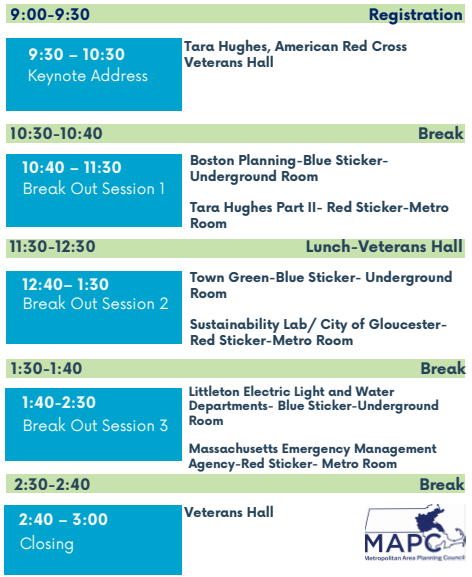
Tara’s keynote address is titled: Who, Where and When – Collaboration in Mass Casualty Crisis
This session will present the framework and timeline for mass casualty response. Focus will be on collaboration with the traditional and non-traditional responders, and keeping those who are impacted at the center of the response.
Event Information and Materials
Breakout Sessions
Integrating Near-, Mid-, and Long-Term Resilience
This session will highlight how Boston is weaving together near-, mid-, and long-term resilience efforts. Presenters will discuss which elements of Boston’s approach could be replicated at a smaller municipal scale and will include flood deployables as a practical example.
Ben Mastusow, Boston Planning Office, Senior Climate and Coastal Resilience Project Manager
Filling the Gap – Helping Residents be Prepared
TownGreen’s newly launched working group, MARCH – Mitigation, Adaptation and Resilient Climate Hub, which serves as a resource for municipalities in the greater Cape Ann area, has embarked on its first regional effort, the Neighborhood Resiliency Project (NRP). The focus of NRP is to work with families and individuals, especially those more vulnerable to hazards, providing them with the tools they need to withstand a climate-induced emergency. Our public safety professionals do an excellent job responding to an emergency, including extensive planning and training. What is missing due to time and resource constraints is educating community members on how they can best be prepared for and respond to an emergency. With a well-prepared citizenry, public safety personnel can focus on the emergency at hand while residents respond appropriately. Getting the word out and filling the emergency preparedness gap is the goal of the Neighborhood Resiliency Project.
Maureen Aylward Bover, Town Green Executive Director
Gregory Federspiel, Director, MARCH
The Long Road Back: A Strategic Framework for Post-Disaster Recovery
Post-disaster recovery is often treated as an improvised, post-event activity rather than a strategic function that can—and should—be planned well in advance. While this session is grounded in a coastal case example, it is intentionally designed to be relevant to a wide range of communities, including near-coastal and fully inland jurisdictions facing hazards such as inland flooding, wildfires, earthquakes, and severe storms. The breakout session explores why pre-disaster recovery planning is essential across hazard types and geographies, and how a strategic recovery framework can help communities anticipate complex disruptions and organize more effective, equitable recovery pathways before disasters occur.
The session draws on an ongoing Commonwealth-funded initiative led by the Sustainable Solutions Lab at UMass Boston, in collaboration with the Cape Ann Climate Coalition and the Cities of Gloucester and Rockport. This work focuses on Gloucester–Rockport’s “Island at Risk” and aims to strengthen financial, policy, and operational readiness for equitable and timely recovery following extreme events.
The first portion of the session will feature two short presentations. Dr. Balachandran will introduce a Strategic Framework for Post-Disaster Recovery currently under development, outlining the rationale for such a framework, key insights from existing risk assessments and plans for the region, and the methodology being used to translate risk scenarios into recovery pathways grounded in nature-based solutions, hybrid coastal infrastructure, and land-use strategies. Collin Buckner will then share the City of Gloucester Office of Emergency Management’s perspective on the practical need for a post-disaster recovery “playbook” that complements emergency response and mitigation planning.
The remainder of the session will be interactive. Participants will work in small groups to apply elements of the framework to their own municipalities or regions, guided by structured discussion prompts. Groups will report back with insights, questions, and suggestions to refine and improve the framework.
Participants will leave with:
– A clearer understanding of why post-disaster recovery planning must occur before disasters strike
– Practical insights from a real-world coastal case
– Transferable ideas for adapting recovery frameworks to their own local contexts
– A deeper appreciation of the often overlooked complexities of recovery, beyond immediate response
Presenters:
Bala Balachandran, Executive Director, Sustainable Solutions Lab (SSL), UMass Boston; Cape Ann Climate Coalition
Collin Buckner, Assistant Emergency Management Director & Compliance Officer, City of Gloucester
Cybersecurity Lessons Learned from Those Who Have Faced Them
This session examines the Volt Typhoon cyberattack on LELWD, in which Chinese state-sponsored hackers infiltrated the utility’s IT network for over 300 days via a vulnerable FortiGate firewall. Attendees will learn about detection strategies, response efforts, and key lessons for safeguarding municipal and critical infrastructure.
Presenters:
Dave Ketchen, Assistant General Manager Littleton Electric Light and Water Departments
Nick Lawler, General Manager, Littleton Electric Light and Water Departments
Preparing for State and Federal Disaster Recovery Support
What municipalities can do prior to, during, and after a disruptive event to put themselves in the best position to take advantage of Federal and State recovery programs.
Including:
- A High-level Overview of Federal Programs – FEMA Public Assistance and Individual Assistance and the Small Business Administration Disaster Loan Program
- An Introduction to the new State Disaster Relief and Resilience Fund (Managed by A&F)
- Best Practices for Municipal Finance in Emergency Situations
- Review of MEMA’s Damage Assessment Process
- Identification of other MEMA Recovery and Field Unit
Presenters:
Primary: Simon Van Leeuwen, Assistant Director for Recovery and Mitigation, Massachusetts Emergency Management Agency (MEMA) – Recovery Unit & Regional Field Office
Supporting: Max Hughes and Matthew Kolhonen, Massachusetts Emergency Management Agency (MEMA) – Recovery Unit & Regional Field Office
Gathering Information and Services_Understanding the first few days of a Mass Casualty Response
Location, Location, Location – this session will focus on the understanding the important places where people will be and what services need to be available. We will focus on timing and transitions between the initial Gathering spot, the Information and Notification Center (Reception Center) and the Family Assistance Center. All discussions will focus on needed collaborations and important foundational understanding of the purpose of each location.
Presenters:
Tara Hughes, Division Disaster Mental Health Advisor, Northeast Division, American Red Cross and Director, Bureau of Justice Assistance National Training and Technical Assistance Center (BJA NTTAC)
Scan or click this QR code to provide feedback after the conference!

Conference Presenter Contact Information
If you would like to connect with any of our presenters:
Integrating Near-, Mid-, and Long-Term Resilience
Presenter: Benjamin Matusow (Boston Planning Office)
Contact: [email protected]
Filling the Gap – Helping Residents be Prepared
Presenters: Maureen Aylward Bover (TownGreen), Gregory Federspiel (TownGreen-MARCH)
Contacts: [email protected]; [email protected]
The Long Road Back: A Strategic Framework for Post-Disaster Recovery
Presenters: Balakrishnan R. Balachandran (UMass Boston), Collin Buckner (City of Gloucester)
Contacts: [email protected]; [email protected]
Cybersecurity Lessons Learned from Those Who Have Faced Them
Presenters: David Ketchen, Nick Lawler (Littleton Electric Light and Water Departments)
Contacts: [email protected]; [email protected]
Preparing for State and Federal Disaster Recovery Support
Presenters: Simon Van Leeuwen, Matthew Kolhonen (Massachusetts Emergency Management Agency), Max Hughes (MEMA)
Contacts: [email protected]; [email protected]
Gathering Information and Services: Understanding the First Few Days of a Mass Casualty Response
Presenter: Tara Hughes (American Red Cross) – also served as Keynote Speaker
Contact: [email protected]
Thank You!
We would like to extend our sincere thanks to all of our presenters for sharing their time, expertise, and insights to make this event a success. Your willingness to contribute and engage helped create meaningful conversations and practical learning opportunities for all involved.
We are also deeply grateful to the Metropolitan Area Planning Council Community Engagement Department for partnering with us to gather and analyze the data that helped shape the direction of this event, as well as the North Shore Task Force for their outreach and assistance.
Thank you to everyone on the Cape Ann Regional Emergency Preparedness Committee for your collaboration in brainstorming this initiative and helping to spread the word across the region. You all are truly fantastic thought partners!
We greatly appreciate the community organizations who welcomed us into their spaces for their time and perspectives, including Pathways for Children in Gloucester, Salem Food Pantry, Pathways for Children in Salem, and Pathways for Children in Beverly. The input we gained from talking to people in your spaces was invaluable in ensuring this event reflected the needs and experiences of the communities you serve.
We also want to thank the municipalities of Rockport, Salem, Topsfield, Nahant, and Peabody for taking the time to share their perspectives and help us better understand which topics and sessions would be most useful for participants through focus groups. These conversations greatly helped us with the development of the day!
Finally, thank you to all of our attendees for your participation, engagement, and commitment to this work. Your involvement is what makes events like this meaningful and impactful!
If you have any questions or comments you wish to share, or if your municipality has emergency preparedness needs or you would like to discuss potential future projects, please do not hesitate to reach out to Beth Robert, Emergency Preparedness Manager at the Metropolitan Area Planning Council, at [email protected]