Top

Framingham Tech Park

Framingham Tech Park Final Report

Read the Framingham Tech Park Final Report

Project background

One of the goals of the Metro Boston Consortium for Sustainable Communities is to collaborate with municipalities and explore opportunities for office and industrial park “retrofits”. As part of these place-based planning efforts, the Framingham Technology Park and 9/90 Corporate Center were targeted for study. This project is being funded by the Metro Boston Consortium for Sustainable Communities.

Study Area Map

MAPC’s role

MAPC is identifying retrofitting opportunities for the Framingham Tech Park and the nearby 9/90 Corporate Center in order to enable more economic development, while reducing per employee vehicle miles traveled and improving access to employment.

We are analyzing multiple aspects of the Tech Park area’s transportation infrastructure and development. Our objective is to develop local land use and transportation demand management (TDM) plans that can be used to prioritize transportation investments, establish a framework for private sector development plans and increase equitable employment opportunities.

This project focuses on the following MetroFuture Goals:

  • Goal 2: Most new growth will occur through reuse of previously developed land and buildings.
  • Goal 45: More people will use transit for work and personal trips.
  • Goal 46: Commuters will have more options to avoid congestion.

Why it’s important

As the Framingham Tech Park and 9/90 Corporate Center grow in size, it is important to analyze the existing transportation alternatives and provide recommendations that will allow for a more sustainable transportation system in the future.

Additional Resources

MAPC Resources

External Resources and Partners

  • Town of Framingham
  • Town of Southborough
  • Town of Ashland
  • MassDOT
  • MetroWest Regional Collaborative
  • MetroWest Regional Transportation Authority
  • MetroWest/495 Transportation Management Association
  • 495/MetroWest Partnership
  • Partnerships for a Skilled Workforce, Inc.
  • Framingham Technology Park and 9/90 Corporate Center Businesses

In the news

Questions?

For more information, please contact Transportation Engineer and Planner Sarah Kurpiel[email protected].

Continue reading...

Boston Region’s Pedestrian Transportation Plan

The Pedestrian Plan identifies actions local governments, advocacy organizations, citizen groups, the private sector, and individuals should take to encourage walking.

Adopted and released in June 2010, the Pedestrian Plan addresses the importance of walking, describes existing pedestrian infrastructure in the Boston Region, and recommends policies and programs that will facilitate walking as a convenient, practical and safe mode of transportation.

Developing the Plan

For over a year, the Pedestrian Plan was developed by working closely with a Pedestrian Advisory Committee and has been extensively reviewed by numerous planning and transportation professionals.

Action Items

In order to implement the goals and guidelines outlined in the Pedestrian Plan, a series of key Action Items have been prepared. The Action Items can serve as a checklist for municipal planners, planning boards, and advocacy groups.

Download the full document of Action Items. The action items comprise four categories:

  • Complete the Pedestrian Network
  • Integrate the Pedestrian Network
  • Design
  • Maintenance and Operation

The Pedestrian Plan

Download the entire Pedestrian Plan below.

Download the Pedestrian Plan by section:

Cover, Credits, Table of Contents
Executive Summary

Chapters:

  1. Introduction
  2. Regional and Local Visions
  3. Walking in the Boston Region 
  4. Current Regional Practices
  5. Community Initiatives  (1.1 MB)
  6. Laws, Codes and Legislation 
  7. Pedestrian Infrastructure Design (2.6 MB)
  8. Funding 
  9. Action Items (1.5 MB)

Appendices (9 MB)

Appendices Contents:

  • Appendix A –  Boston Region Commuting Patterns & Vehicle Ownership
  • Appendix B – Sidewalk Coverage by Municipality
  • Appendix C – Pedestrian Fatalities within the Boston Region
  • Appendix D – Pedestrian-Related Issues to consider when Reviewing Development Plans
  • Appendix E – Resources

Sidewalk Inventory

Eight maps comprise the ‘Sidewalk Coverage by Municipality’ in the Boston Region and identify whether sidewalks exist, on one side, both sides, or neither side for ‘Main Roads’ and ‘Local Roads.’

Inventory Map Index

How Can I Get a Copy of the Plan?

Paper copies and CD roms of the Pedestrian Plan are available upon request. Please contact Alison Felix, Transportation Planner, [email protected].

How Can I Get Involved?

If you are interested in hosting a Walkable or Livable Community Workshop, please contact Eric Bourassa, Transportation Manager, at 617-451-2770, ext. 2043 or [email protected].

Other resources

Comments and Questions?

If you have questions or editorial comments, please e-mail them to Eric Bourassa, Transportation Manager, [email protected].

Continue reading...

Community Health Needs Assessments in the MAPC Region

Community Health Needs Assessments in the MAPC Region

Community health assessments (CHAs) are becoming more and more ubiquitous.  Most prominently, the IRS now mandates that tax-exempt hospitals perform community health needs assessments every three years. Similarly, through a program launched in 2011, the Public Health Accreditation Board (PHAB) requires local public health departments seeking national accreditation to conduct a CHA.

Not only are CHAs required for hospitals and public health departments, but health maintenance organizations (HMOs), federally qualified community health centers, community action agencies (CAAs), community development financial institutions (CDFIs), and even Massachusetts’s transportation projects can be required to conduct similar, if not the same, health assessments.

All of these cross-sectoral players performing health assessments lead to a confusing, often overlapping and duplicative environment of community health profiles.

In the Greater Boston region, many organizations required to perform CHAs, as well as those that work with the assessments, have started to recognize the overlap among the various organizations’ work. These same organizations, as well as others who see the value in the CHA process and outputs, are now considering possible opportunities to collaborate, reduce redundancies, and maximize impact.

Figure 1 - Conceptual Illustration of Overlapping CHA Geographies
Figure 1 – Conceptual Illustration of Overlapping CHA Geographies

Questions? Comments?

For more information and to propose changes, please contact Public Health Manager Barry Keppard or any member of the Public Health Team at MAPC.

Community Health Assessments

MAPC has collected CHAs in the Greater Boston region in an effort to understand the landscape better and make the information more accessible.

The following table contains CHAs by Community Heatlh Network Areas (CHNAs), Health Centers, Health Foundations, Hospitals/Hospital Systems, the state (MA DPH), and Municipalities. It is a working inventory and we look forward to updating and adding to this table as additional assessments are identified.

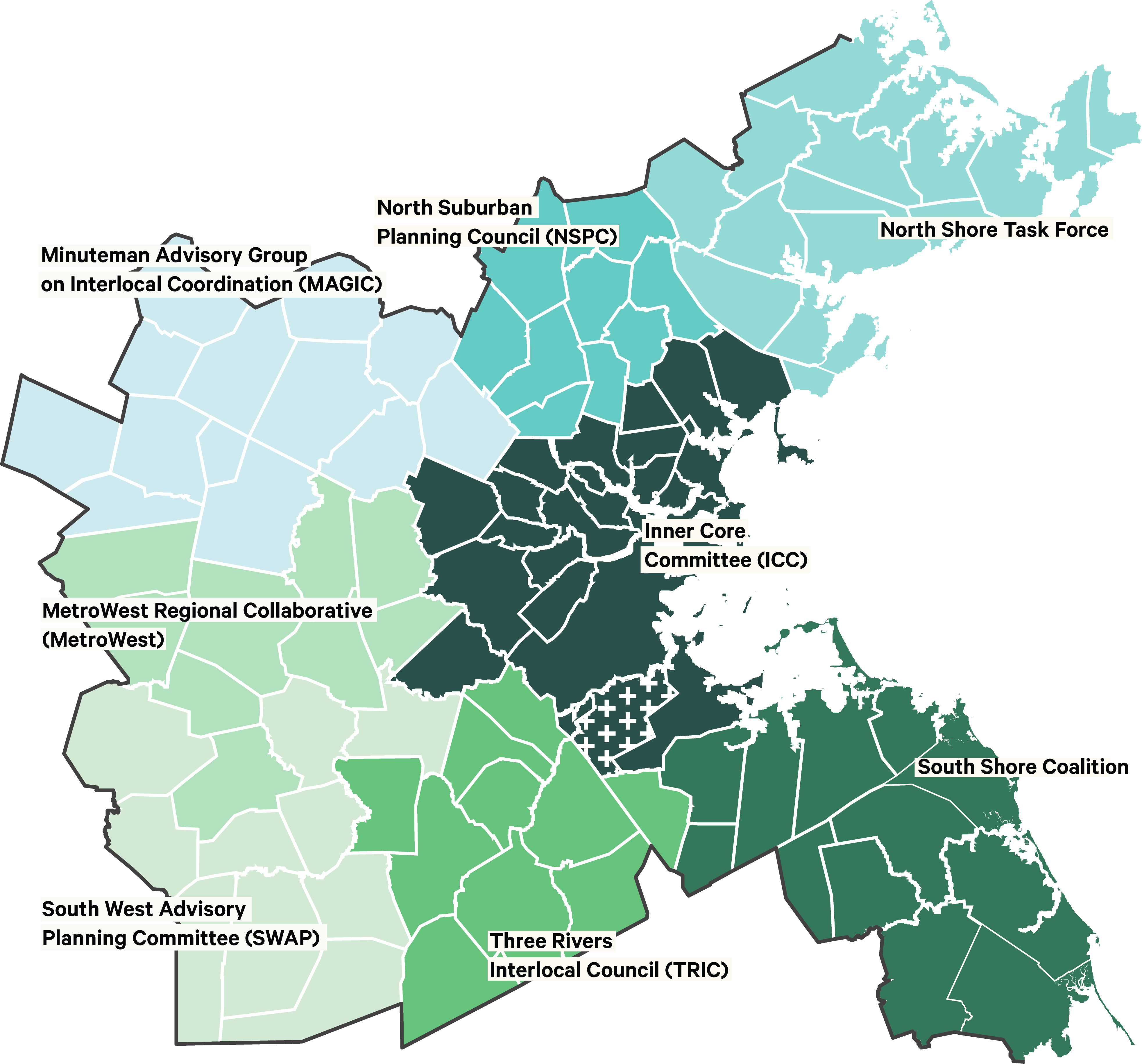
Image is a a map of the region MAPC serves, broken out into subregion.
Hospitals & Health Systems
Organization Health Year Subregion MAPC municipalities included in catchment
Boston CHNA/CHIP Collaborative 2019 ICC Boston
North Suffolk CHNA 2019 ICC Chelsea, Revere, Winthrop

*MAPC was involved in the North Suffolk CHNA

Brigham and Women’s Hospital 2013, 2019 ICC Boston (priority neighborhoods: Dorchester, Jamica Plain, Mattapan, Mission Hill, and Roxbury)
Brigham and Women’s Faulkner Hospital 2013, 2019 ICC Boston (priority neighborhoods: Jamaica Plain, Hyde Park, Roslindale, and West Roxbury)
Beth Israel Deaconess Medical Center 2013, 2019 ICC Boston (priority neighborhoods: Allston/Brighton, Bowdin/Geneva, Chinatown, Fenway/Kenmore, and Roxbury/Mission Hill)
Beth Israel Deaconess Medical Center Milton 2013, 2019 ICC, SSC Primary: Milton, Quincy, and Randolph.

Secondary: Braintree, Canton, and Weymouth

Beverly Hospital 2019 NSTF Beverly, Danvers, Essex, Gloucester, Ipswich, Lynn, Manchester, Middleton, Rockport
Boston Medical Center 2013, 2019 ICC Boston
Boston Children’s Hospital 2013, 2016, 2019 ICC Boston
Carney Hospital 2012, 2018 ICC, SSC Boston (Dorchester, Mattapan, South Boston, Hyde Park) Braintree, Milton, Quincy
Emerson Hospital  2018 MAGIC Acton, Bedford, Bolton, Boxborough, Carlisle, Concord, Harvard, Hudson, Lincoln, Littleton, Maynard, Stow, Sudbury and Westford
Dana Farber Cancer Institute
(cancer specific in collab with BMC) 
2012, 2019 ICC Boston
Mass General Hospital 2012, 2019 ICC Boston
McLean Hospital 2019 ICC* Arlington, Belmont, Cambridge, *Middleborough, Somerville, Waltham, and Watertown
Melrose Wakefield Healthcare (Formerly Hallmark Health System) 2016, 2019 ICC, NSPC Everett, Malden, Medford, Melrose, North Reading, Saugus, Stoneham, Wakefield
Lahey Hospital and Medical Center 2012, 2016, 2019 ICC, MAGIC, NSPC, NSTF Arlington, Bedford, Billerica, Burlington, Lexington, Lowell, Lynnfield, and Peabody
Lawrence General Hospital 2013, 2019 NSTF Middleton
Marlborough Hospital 2013, 2019 MAGIC, MWRC, SWAP, TRIC Stow, Maynard, Hudson, Sudbury, Wayland, Marlborough, Framingham Natick, Southborough, Ashland, Hopkinton, Holliston, Sherborn, Millis, Medfield, Walpole, Norfolk, Wrentham, Foxborough
Massachusetts Eye and Ear Infirmary 2013, 2019 ICC Primary: Boston

Secondary: Cambridge, Brookline, Revere, Quincy, Somerville, Medford, Malden, Chelsea, Lynn, Everett, Arlington, Stoneham, Saugus, Melrose

Massachusetts General Hospital, Charlestown 2012 ICC Charlestown, Boston
Milford Regional Medical Center and Healthcare Foundation 2015, 2018 SWAP Bellingham,Franklin, Holliston, Hopkinton, Medway, Milford, Millis, Medfield, Norfolk, Wrentham
Mount Auburn Hospital 2012, 2018 ICC Cambridge, Somerville, Arlington, Belmont, Watertown, Waltham
New England Baptist Hospital 2013, 2019 ICC, TRIC Boston, Brookline, Dedham, Chestnut Hill
Newton-Wellesley Hospital 2014, 2018 ICC, MWRC Natick, Newton, Waltham, Wellesley, Weston
North Shore Medical Center 2012, 2018 NSTF, NSPC Danvers, Lynnfield, Peabody, Salem, Marblehead, Swampscott, Lynn, Nahant
Norwood Hospital 2012, 2018 TRIC, SWAP Canton, Dedham, Dover, Franklin, Foxborough, Medway, Medfield, Millis, Norfolk, Norwood, Sharon, Stoughton, Walpole, Westwood
Quincy Medical Center 2012 ICC Quincy
Shriners Hospitals for Children 2018 ICC Boston
South Shore Hospital 2013, 2019 TRIC, SSC Canton, Norwood, Sharon, Quincy, Milton, Randolph, Braintree, Weymouth, Higham, Cohasset, Scituate, Norwell, Stoughton, Holbrook, Rockland, Hanover, Pembroke, Duxbury, Marshfield,
Spaulding Hospital – Boston 2018 ICC Boston, Cambridge, Revere, Somerville, Medford, Chelsea, Lynn, Malden, Everett, Newton, Quincy, Brookline, Winthrop, and heavy focus on Charlestown
Spaulding Hospital – Cambridge 2019 ICC Boston (Dorchester), Cambridge, Waltham, Somerville, Revere, Medford, Lynn, Malden, Everett
St. Elizabeth Medical Center 2012, 2018 ICC, MWRC Boston (Allston, Brighton, Back Bay, West Roxbury), Newton, Waltham, Watertown, Weston
Tufts Medical Center 2013, 2019 ICC Boston (Chinatown, Dorchester, South Boston, and South End), Quincy
Winchester Hospital 2013, 2019 ICC, NSPC Wilmington, North Reading, Reading, Wakefield, Stoneham, Woburn, Winchester, Medford


Community Health Network Areas
Community Health Centers
MADPH
Municipalities
Non-Profit Organizations
Continue reading...

Main Street Corridor Study

Project Description

MAPC collaborated with Reading, Wakefield and Melrose to develop a coherent, forward-looking transportation plan. The Main Street Corridor Study looks at ways to improve upon the existing transportation network byreducing automobile traffic while promoting commuter rail, walking, bicycling and bus transportation.

This study addresses a full range of transit options and focuses on achieving sustainable development and land use objectives. Opportunities to implement compact growth and transit-oriented development strategies that can elevate Main Street to a greener, more accessible multi-modal transit corridor were explored. The Main Street Corridor Study’s goals and strategies will improve accessibility, coordinate transportation systems, promote healthy life-style choices, as well as conserve natural resources benefitting Reading, Wakefield and Melrose, and the region as a whole.

Recommendations

Nine goals were developed based on feedback from interactive community forums, meetings with the planners of Reading, Wakefield and Melrose, site visits, and research. Focusing on the needs of those who live, shop and travel along Main Street, the goals and strategies address improving accessibility between places, promoting walking and safety for pedestrians and bicyclists, compatibility with public transit, and less reliance on cars. Detailed in the report, the nine goals are:

  • Improve Pedestrian Access and Amenities
  • Improve Bicycle Access and Amenities
  • Increase Transit Use and Improve Connections
  • Advance Environmentally Friendly and Efficient Transportation Alternatives
  • Improve Access and Accessibility for Senior Transportation Services
  • Increase Signage between Downtowns and Commuter Rail Stations
  • Improve Access to Local and Regional Open Spaces and Recreation Destinations
  • Ensure Zoning and Development Regulations Coordinate with and Support Alternative Modes of Transportation
  • Ensure Transportation Infrastructure Compliance with State and Federal Accessibility Regulations

Public Process

Three interactive, Community Forums were held, one in each community, to present existing data and observations, and to gather input and suggestions from area residents, employees and business owners. Feedback from the Community Forums contributed to developing the Main Street Corridor Study.

  • Reading
  • Wakefield
  • Melrose

Press Coverage

For more information, contact MAPC Transportation Planner Alison Felix at 617-451-2770 x2048 or [email protected] , or MAPC Transportation Planner and Engineer Sarah Kurpiel at 617-451-2770 x2053 or [email protected].

Continue reading...

Pedestrian and Bicycle Planning Network

For information about the LandLine, please click here.

Final Reports

Project background

As stated in the Consortium for Sustainable Communities Three-Year Work Plan (dated May 24, 2011), incomplete pedestrian and bicycle infrastructure contributes to auto dependency. Comprehensive planning is a critical first step in helping to improve connectivity. MAPC aims to assist numerous communities within the Sustainable Communities Consortium with pedestrian and bicycle planning efforts.

MAPC’s role

MAPC will assist several clusters of communities in advancing pedestrian and bicycle planning, at the local level and create networks for safe non-vehicular travel. This effort will be conducted at no cost to the municipality. The community clusters include:

  1. 1.  Town of Dedham, Town of Westwood
  2. 2.  City of Chelsea, City of Everett, City of Revere, City of Malden, Town of Saugus, City of Lynn
  3. 3.  City of Quincy
  4. 4.  Town of Hudson, Town of Stow, Town of Maynard, Town of Marlborough

An additional goal is to provide safe access to major pedestrian and bicycle destinations within the cluster, including the Assabet River Rail Trail, the Dedham Rail trail (providing access to the Neponset trail), and the Northern Strand Community Trail (Bike to the Sea). In the south shore, we propose to work with Quincy to recommend an alignment for a priority greenway from Boston. Access to major employment centers, local schools, and parks will also be prioritized.

Existing conditions and potential opportunities will be identified for each area, including priority connections and routes, proposed bicycle and pedestrian accommodations, cross-sections for the major collector roads, and opportunities for implementation funding.

The proposed accommodations could include: exclusive bicycle lanes, sharrows, cycle tracks, new sidewalks, and improved surface conditions. At the conclusion of the planning effort, it would be the responsibility of the individual municipalities to implement the recommendations.

This project works towards the MetroFuture goal of providing an improved transportation system that provides more choices for residents and businesses

Why it’s important

Rather than small-scale planning of individual neighborhoods, large-scale planning of community clusters allows for greater regional impacts, establishing regional priorities, and a significant increase in potential users.

Additional resources

External resources and partners:
  • 13 Community Partners (listed above)
  • WalkBoston
  • MassBike
  • Liveable Streets Alliance
In the news

Questions?

For more information, please contact:

Transportation Engineer and Planner Sarah Kurpiel, [email protected] or Transportation Planner David Loutzenheiser[email protected]

Continue reading...

Salem Point Neighborhood Vision and Action Plan

Background

The Point neighborhood in the City of Salem includes nearly 144 acres and 4,100 people, and is located just south of the downtown and wharf areas. The Point is distinguished from surrounding neighborhoods by its geography, density, high proportion of multi-family housing and masonry apartment blocks, and a high concentration of recent immigrants.

Neighborhood resources include rich architectural assets, a significant supply of affordable housing, immigrant-owned small businesses, easy access to Salem Harbor and public transit, and close proximity to Salem State University. It is also a vibrant, ethnically-diverse community that has long been a settlement destination for newcomers.

This Salem Point Neighborhood Vision and Action Plan project was a collaboration among city, regional, nonprofit and grassroots stakeholders to develop a vision for improving the Point neighborhood between 2013 and 2020. The Plan is now bring implemented through the leadership of an Advisory Group that is stewarding plan implementation.

What’s New: Salem Point Neighborhood Commercial Corridors Revitalization Plan Finalized

In spring 2014, the City of Salem received funding through the 2014 District Local Technical Assistance program to undertake a Commercial Corridors Revitalization Plan in collaboration with the North Shore Community Development Corporation and MAPC. This project advances the housing and economic development vision outlined in the Plan. A portion of the work is also funded through a Working Cities Challenge Grant.

The Plan evaluates the retail market, housing, and mixed use redevelopment potential of parcels in the Congress and Lafayette Street corridors and also examines potential in connective corridors including Peabody, Harbor, and Palmer streets. The Plan includes a retail market analysis and an analysis of parcel development or redevelopment potential, resulting in an action plan that aims to boost economic activity and inclusivity in the Point and better connect it with the booming downtown economy. The Corridors Plan was completed in December 2014.

Download the Salem Point Neighborhood Commercial Corridors Revitalization Plan


Salem Point Vision and Action Plan, 2013-2020

The Salem Point Neighborhood Vision and Action Plan outlines a vision to improve the quality of life in the Point neighborhood and an action agenda that the City of Salem and community partners will work together to implement over a seven-year period from 2013-2020.


This Plan is a product of a year-long grassroots, neighborhood-level visioning process where city officials and community leaders, residents, students, service providers, property owners, and others engaged in a series of conversations to consider practical approaches for building upon the assets of the Point and making it an even better place to live, work, study, and visit. The Action Plan was completed in August 2013.


“What’s the Point?”a Community PlanIt Game

One part of this project’s outreach and engagement strategy was the use of Community PlanIt, a web-based game where community members electronically interacted with one another on their smart phone or computer to contribute ideas about the neighborhood. In the game, community members (players) participated in online challenges, collect coins for participation, and pledged coins to Causes — real-world organizations or nonprofits — to fund services or activities that benefit the neighborhood. Between January 28 and February 18, people who live, work, study, and play in the Point played the game.


Now that game play is over, the website has converted to a post-game state where you can see comments people have left and summary stats on player responses to questions in the game: www.communityplanit.org/salempoint.

Here’s a primer on the Community PlanIt game. This video was produced by our game development partner, Emerson Engagement Game Lab.

Point Neighborhood Walking Tour

View photos from a recent walking tour MAPC conducted with youth from the North Shore CDC Youth Jobs program. Phgoos taken will go into the design for “What’s the Point?” a Community PlanIt game that will be launched in the early spring and provides another avenue for residents within and outside of the Point to weigh in on assets and opportunities in neighborhood.

Partner roles

The project was initiated by the City of Salem and the North Shore Community Development Coalition (NSCDC) with the support of MAPC and is funded by the Metro Boston Consortium for Sustainable Communities.

  • MAPC is working with the City of Salem and NSCDC to synthesize existing data about the Point, helping to plan and facilitate public meetings, and preparing all final project deliverables. MAPC is also coordinating the participation of Emerson Engagement Game Lab, which is developing and implementing the Community PlanIt igame.
  • NSCDC is undertaking all outreach and engagement for development of the vision statement and action plan, including canvassing, surveying, and small-scale community meetings and neighborhood-wide meetings.
  • The City of Salem is assisting with the compilation of content from existing studies pertaining to the Point, planning and facilitating the second public meeting, and assessing impediments and opportunities to implementing the neighborhood vision.

Why it’s important

The project aimed to empower residents to create their own community vision and to mobilize resources to ensure that the Point develops sustainably in its housing, land and environmental resources, and its economy. Project partners hope that the resulting Action Plan guides municipal priorities for local capital and operating improvements.

This project supports MetroFuture’s Sustainable Growth Patterns , Housing Choices , Community Vitality, and Healthy Environment goals for the region.

Questions?

For more information about this project, please contact:

  • Jennifer Erickson, MAPC Regional Planner and Equity Specialist at [email protected] or 617-933-0759
  • Lynn Duncan, AICP, Director of Planning and Community Development for the City of Salem at [email protected] or 978-619-5685
  • Mickey Northcutt, Executive Director of the North Shore Community Development Coalition, [email protected] or 978-745-8071


Continue reading...

Neponset River Watershed Water Management Act Planning

MAPC

Promoting Smart Growth & Regional Planning

JUNE 2013

Neponset River Watershed Water Management Act Planning

Project Background

Integrated Water Management (IWM), sometimes termed “Total Water Management,” is the exercise of stewardship of water resources for the greatest good of society and the environment. It is a comprehensive, planning method for managing water resources in a way that balances social and economic needs, and that ensures the protection of ecosystems for future generations. Although , not the primary focus of the project, the Neponset River Water Management Act Planning project will serve as an example of IWM, as planning was completed planning across all water sectors (wastewater, drinking water, and stormwater).

Purpose

The primary purpose of the project was to evaluate how communities in the Neponset, and surrounding watersheds, are likely to be affected by the Water Management Act (WMA) rules. Project partners explored a variety of options for them to consider that would address the new WMA regulatory requirements recommended by the Sustainable Water Management Initiative Advisory Committee and reduce the environmental impacts of water supply activities on the Neponset, Charles, Taunton and/or Ten Mile Rivers.

Scope

The project involved assembling much of the information and analysis which the participating communities will need to submit their WMA permit renewal applications in 2015. Specific tasks included:

  • Developing multiple scenarios regarding the volume of water that will be needed in the future, and creating an interactive water needs forecasting model for the study area.
  • Evaluating existing water conservation practices in each community and additional steps that could be taken to increase water-use efficiency.
  • Quantifying existing wastewater returns and the potential to further reduce water losses associated with groundwater leaking into the regional sewer system.
  • Assessing the potential to reduce environmental impacts by shifting pumping among existing wells, adding new wells in less sensitive areas, or importing water through regional interconnections.
  • Exploring opportunities to increase groundwater recharge by retrofitting existing roadways and parking lots with devices to capture and clean polluted stormwater runoff which is currently discharged directly to waterways.
  • Summarizing the regulatory thresholds and requirements likely to apply to each community and some of the options available for addressing those requirements.

Project Partners

The Metropolitan Area Planning Council’s Environmental Division had the privilege to partner with a unique group of organizations with varying perspectives and qualifications to make the project a success: the Neponset River Watershed Association, and Weston and Sampson Engineering.

Outcomes

In general, the project found that the growth in water demand in the study area is likely to be gradual over the next 20 years. Therefore, communities can address the new regulatory requirements and substantially reduce impacts to waterways by being proactive in implementing a variety of incremental changes in the areas of water conservation, wastewater management, stormwater management, and optimization of withdrawals.

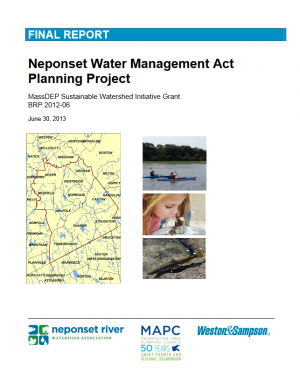
The project final report can be downloaded here (note: large file – 27MB). A presentation prepared by the project team can be downloaded here. Additional documentation, data and work products associated with this project are available to designated representatives of the participating communities on a set of two project DVDs.

Contact

For further information contact Martin Pillsbury, MAPC Environmental Planning Director ([email protected]) or Ian Cooke, Neponset River Watershed Association, Executive Director ([email protected]).

Continue reading...

Green Line Extension

Project background

green line at Park street station

MAPC worked with the cities of Medford and Somerville to gather community input on the possibility of extending the Green Line to Mystic Valley Parkway/Route 16, and to study potential land uses and transit-oriented developments in the area.

The planning study is funded by the Massachusetts Department of Transportation (MassDOT), which will be actively involved in the process, along with the MBTA.

MAPC’s role

MAPC lead a community visioning process to examine how a future Mystic Valley Parkway station could foster transit-oriented development in the area, while minimizing negative impacts to the local community.

Green Line Extension Report

The final version of the Green Line Extension report is now available for download below

The report includes MAPC’s recommendations for the proposed Green Line extension along the Mystic Valley Parkway.

Community Visioning Process Meetings

MAPC hosted a series of public input meetings in conjunction with the Massachusetts Office of Public Collaboration and MassDOT. We hope to help facilitate strong public engagement throughout the Mystic Valley Parkway visioning process.

Community Visioning Process FAQs

Continue reading...

Autonomous Vehicles


Autonomous Vehicles

MAPC | Promoting Smart Growth & Regional Planning

The deployment of autonomous vehicles holds the potential to positively transform the transportation network.

MAPC supports transportation that provides sustainable, accessible, and affordable service to the 101 cities and towns in the MAPC region. We recognize the transformative benefits that autonomous vehicles can have for Massachusetts’ economy, environment, and quality of life – as well as the challenges that could result from disruption to existing forms of mobility. Autonomous vehicles will affect not only our transportation system, but also our economy, safety, workforce, environment, land use, and energy use.

The deployment of autonomous vehicles holds the potential to positively transform the transportation network. The positive transformational impacts include strengthening public transportation, reducing crashes and fatalities for drivers, pedestrians and bicyclists, as well as reducing traffic congestion and greenhouse gas emissions. Autonomous vehicles also have the capability to lessen the need for parking facilities and increase mobility for those who cannot drive.

Little electric car

Questions?

For more information, contact Senior Transportation Planner and Emerging Technologies SpecialistAlison Felix.

Legislative & Policy Considerations

In May 2017, the MAPC Executive Committee adopted a set of legislative and policy considerations. The intent of the legislative and policy considerations is to encourage the Commonwealth and our member municipalities to safely and equitably accommodate autonomous vehicles on the roadway network. Considerations outlined include data collection and data sharing, potential changes to municipal and state revenue, public infrastructure, safety, speed limits, autonomous delivery of goods, land-use, parking, and long-range planning.

Click here to read the full document.

AUTONOMOUS VEHICLES:

MOU Signing

Companies looking to test autonomous vehicles on Massachusetts roads will now have a much easier time experimenting on a variety of road conditions, thanks to a MAPC-facilitated Memorandum of Understanding streamlining and standardizing the application process.

On Thursday, June 21, representatives from 14 cities and towns, the Massachusetts Department of Transportation, and the Department of Conservation and Recreation gathered with Governor Charlie Baker and local technology companies to launch the agreement, which will allow testing of autonomous vehicles to expand in Massachusetts. Read the recap here.

Autonomous Vehicles Signing Event

AUTONOMOUS VEHICLES:

EDUCATIONAL FORUM IN ARLINGTON

MAPC collaborated with the Town of Arlington and organized an evening educational forum on November 14, 2017 on the topic of autonomous vehicles. The event included industry experts and addressed the implications of AVs on policies, regulations, and infrastructure.

Driverless cars forum:

What will they change – and when?

On June 13, 2016, MAPC and Transportation for Massachusetts (T4Mass) hosted a forum exploring the transformative technology of autonomous vehicles and their likely impacts. The event gathered an audience of 250 at the Massachusetts Institute of Technology.

The forum featured an expert panel from both the public and private sectors and covered topics including driverless car technology, timeframe for implementation, how driverless cars could change the role of transit in communities, and the role of government in the process.

Christopher Zegras, Associate Professor
Department of Urban Studies and Planning, MIT

Marc Draisen, Executive Director
Metropolitan Area Planning Council

Tony Dutzik, Senior Policy Analyst
Frontier Group

Lauren Isaac, Manager of Sustainable Transportation 
WSP | Parsons Brinkerhoff

Jonathan Koopmann, Senior Engineer, Technology, Innovation and Policy Division 
U.S. DOT/ Volpe Center

Mayor Joseph A. Curtatone
City of Somerville

Kent Larson, Director of the City Science Initiative & the Changing Places Group
MIT Media Laboratory

Continue reading...

Natick Center Plan

Natick Center has witnessed a great transformation since 40 years ago, when the last Master Plan for the community was completed in the 1970s. At that time, the plan for Natick Center was to utilize 1950s and 1960s-style urban renewal techniques to “revitalize” downtown.

Fortunately, those efforts did not come to fruition. Natick Center in 2015 is rich with revitalized historic and new properties, largely occupied with a mix of commercial, retail, cultural, residential, and civic uses.

The purpose of the Natick Center Plan is to work with the Town, property owners, business owners, and citizens to craft a vision for short- and long-term changes to capitalize on the current and future assets in Natick Center. The project will engage the public in a discussion about how Natick Center can support the needs of the residents and businesses today, as well as those who may be here in the future. We will look at potential opportunities for redevelopment, which will include ways to improve the current utilization of existing buildings in the Center. We will look closely at parking needs, parking ratios, and impact new growth could have on the current parking supply. We will also recommend ways to improve multimodal transportation connections within and outside Natick Center.

The goal of the Natick Center Plan is to develop a clear action-oriented path for the Town and other stakeholders that will help maximize the benefits to the Town and take advantage of the Center’s proximity to public transportation.

Sign up here to join the Natick Center Plan mailing list.

Final Report

Chris Kuschel presented the final report to the Board of Selectmen on May 31, 2016. Download the report here.

Public Forum 2/10/2106

A well-attended forum was held on February 10, 2016, to allow the public to comment on the draft recommendations developed by the MAPC. The slides from the presentation are here.

“Virtual Forum” survey

Link to “Virtual Forum” survey
Survey End Date: Friday, 1/15/2016

Those unable to attend the Public Forum on 12/8/2015 or unable to participate fully can now add their input to the Natick Center Plan by way of an online survey. We’re calling it a “Virtual Forum” survey, because it not only solicits opinions, but provides much of the demographic and other information presented at the Public Forum. The deadline for returning the survey is 1/15/2016.

Public Forum 12/8/2015

Next Steps

Several surveys will be distributed during December. One survey will be for people who were unable to attend the forum, and the other will be a follow-up for both groups.

The feedback garnered from the surveys will be combined with information from discussions with Town officials, and opinions gathered at a 12/3/2015 “pop-up” feedback booth at the Natick Center T station and at the 12/8/2015 forum. All of this input will inform the draft recommendations that will be developed by MAPC over the next months. MAPC will present these recommendations at a yet-to-be-scheduled meeting in early 2016 and gather additional feedback. That meeting will be widely publicized.

MAPC’s Role

MAPC will be assisting the Town in working with the public to identify the key opportunities and impediments to creating a vibrant, active, and well-connected neighborhood. To help inform the overall process, MAPC will be completing a commercial and residential market analysis, reviewing the existing zoning, reviewing parking, and exploring what improvements could be made to the roadways and pedestrian connections within Natick Center.

Questions and Updates

For questions about this project, please contact Chris Kuschel, [email protected]

Continue reading...